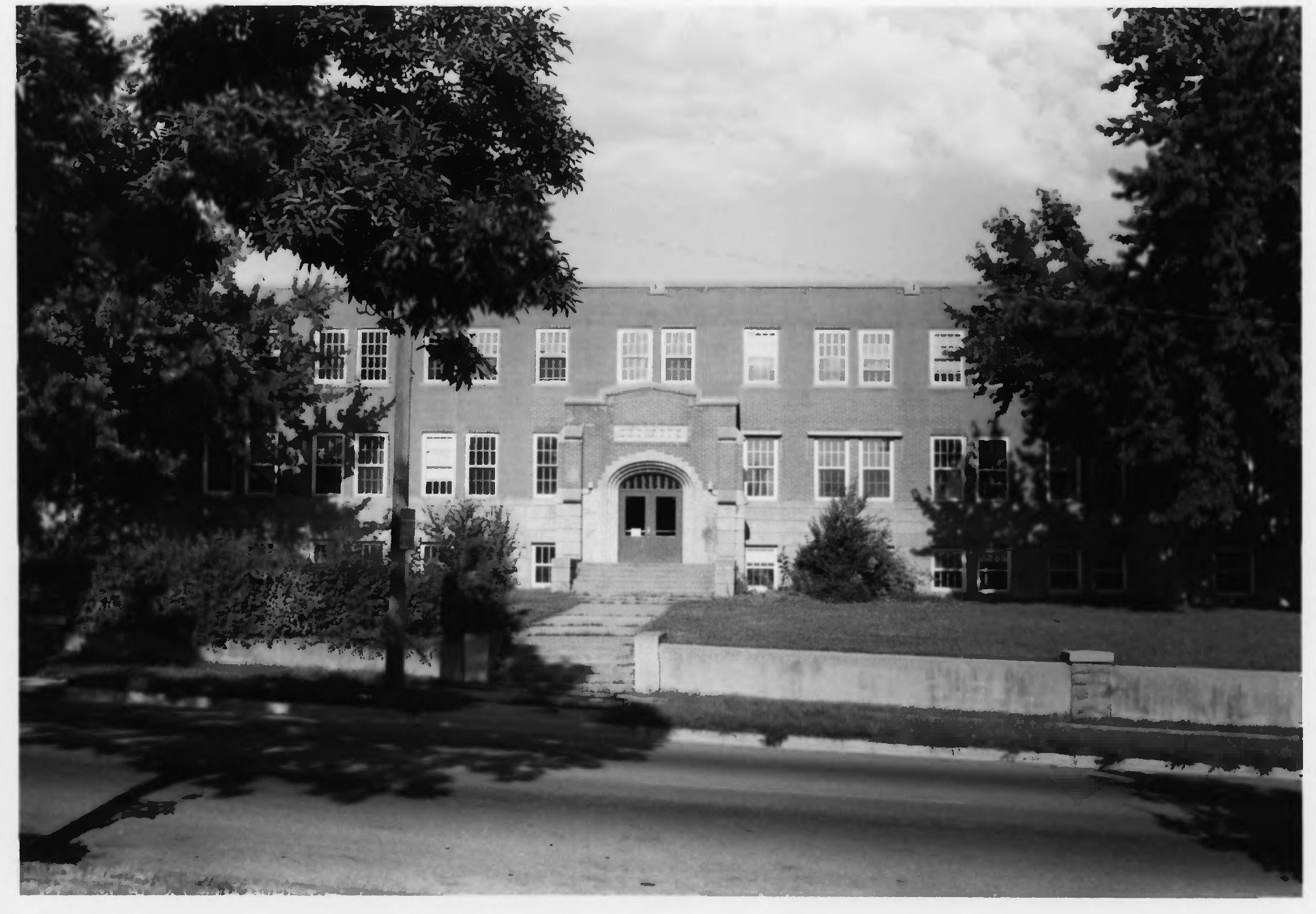
The Presentation Children's Home photographed for the National Register nomination in 1992

Across town

The Presentation Children's Home.

An orphanage burned at Turton in 1932. Eight years later the children had a building in Sioux Falls, put up with federal labor because the city agreed to sign for it. It stands at Fifteenth and Western, and the order that ran it is the order that ran Helen McKennan's hospital.

One

What the marker says.

Two bronze faces on a post at the sidewalk, put up in 2005 by the Minnehaha County Historical Society — the same society that marked the band shell, the zoo and the Statue of Liberty in McKennan Park. This is the whole of the text, both sides, as cast.

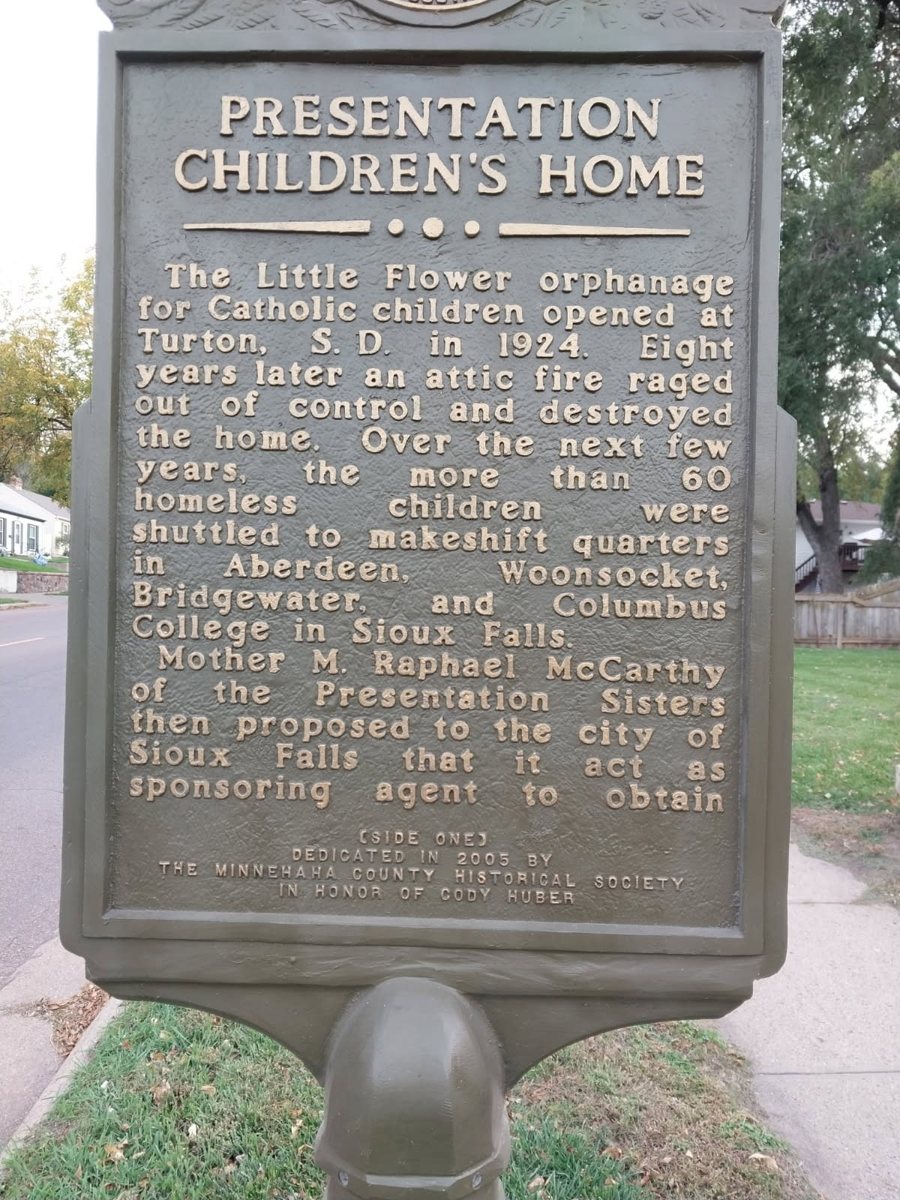
Presentation Children's Home, side one

“The Little Flower orphanage for Catholic children opened at Turton, S.D. in 1924. Eight years later an attic fire raged out of control and destroyed the home. Over the next few years, the more than 60 homeless children were shuttled to makeshift quarters in Aberdeen, Woonsocket, Bridgewater, and Columbus College in Sioux Falls.

Mother M. Raphael McCarthy of the Presentation Sisters then proposed to the city of Sioux Falls that it act as sponsoring agent to obtain…”

Dedicated in 2005 by the Minnehaha County Historical Society in honor of Cody Huber. Who Cody Huber was is not recorded on the marker or in the marker database, and this page does not guess.

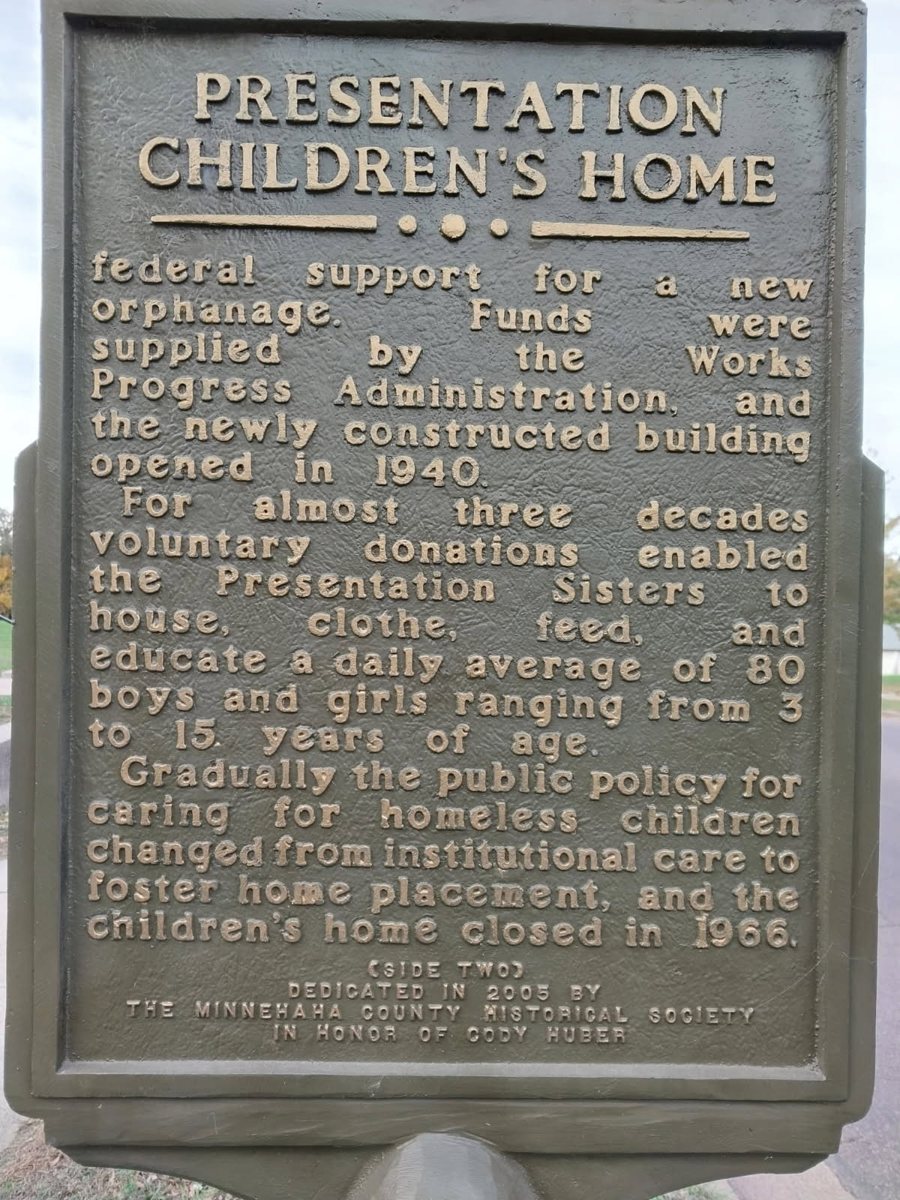
Presentation Children's Home, side two

“…federal support for a new orphanage. Funds were supplied by the Works Progress Administration, and the newly constructed building opened in 1940.

For almost three decades voluntary donations enabled the Presentation Sisters to house, clothe, feed, and educate a daily average of 80 boys and girls ranging from 3 to 15 years of age.

Gradually the public policy for caring for homeless children changed from institutional care to foster home placement, and the children's home closed in 1966.”
The sentence runs across the two faces; the first ends mid-clause. Read them in order or the money makes no sense.
The marker, side one
Side one. Photographs of the Presentation Children's Home and its marker, 701 South Western Avenue, Sioux Falls, October 2026, taken for this site.
The marker, side two
Side two, read second.

Two

Turton, and eight years of borrowed rooms.

The National Register nomination, filed in 1992 from the order's own archives at Presentation Heights in Aberdeen, tells the part the marker compresses. From 1907 to 1932 the Little Flower Home at Turton served as orphanage and parochial school for the surrounding country and the Diocese of Sioux Falls. On 21 March 1932 fire destroyed it. Between sixty-five and seventy-three orphans were left homeless and thirty-three parochial students were left without a school, in the third year of the Depression.

What followed was eight years of other people's buildings. The children went first to Graham Hall at Northern Normal College in Aberdeen, for a short time; then to St. Joseph's School at Woonsocket, for two years. In 1934 the Columbus College building in Sioux Falls was offered to the order. The children came by train that summer, and the Columbus Children's Home was established in a building that was overcrowded from the day they arrived. The sisters asked the city to help them find something permanent, and the nomination's phrasing is flat enough to be believed: none were available, suitable, or large enough.

Three

How a Catholic order got a federal building.

The mechanism is the interesting part, and it is the reason the marker exists. Federal relief labor could not simply be handed to a religious order. It went to public sponsors. So the City of Sioux Falls became the sponsor of record, applied to the Works Progress Administration, and the order built an orphanage with government labor on that footing.

The paper trail runs through the city commission. Sister M. Francis wrote to the state WPA director in March 1938. The commission adopted its first resolution on 4 November 1938 and four more between November 1939 and September 1940. The sisters hired Hugill & Blatherwick, the Sioux Falls firm that specialized in institutional buildings and worked on relief projects throughout the Depression, and the architects estimated $100,000. The city and the WPA covered roughly half; the order raised the rest in charity drives. Construction ran through 1939 and the building opened in 1940.

For the next twenty-six years it held a daily average of eighty boys and girls, aged three to fifteen, paid for by donations rather than by the state.

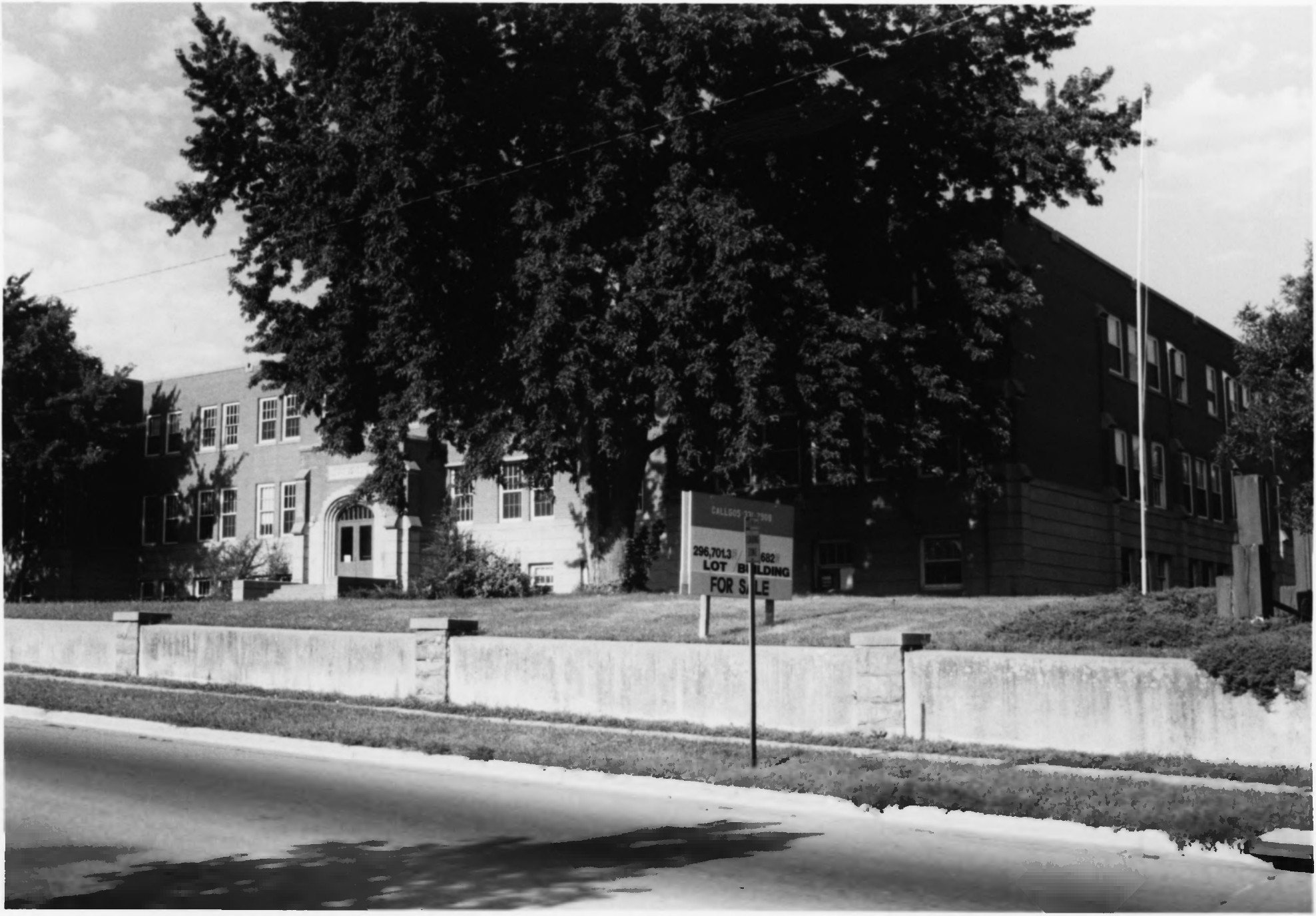
The Presentation Children's Home from Western Avenue in 1992, with a for-sale sign in the yard
From Western Avenue in 1992, fifty-two years after it opened and twenty-six years after the children left: empty, with a lot-and-building-for-sale sign on the lawn. Photograph submitted with the National Register of Historic Places nomination for the Presentation Children's Home, 1992; National Park Service, public domain.

Four

The building.

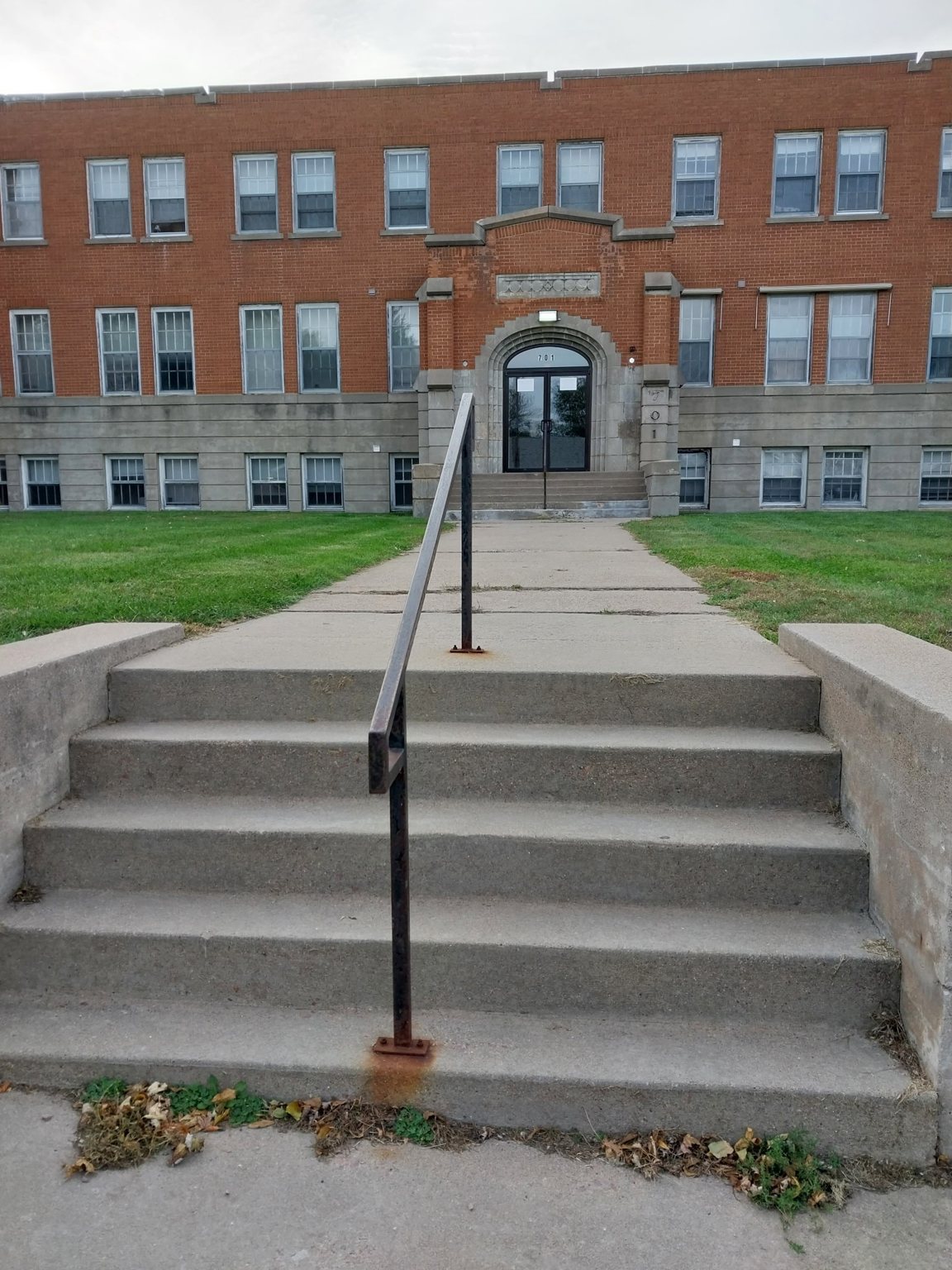
Two storeys of red pressed brick and poured concrete in an H plan, with simplified Collegiate Gothic detail: corner buttresses at the projecting entrance, a recessed door with a fanlight, concrete sills and an ornamental parapet. The ground falls away to the west, so the basement is a walk-in level at the back. The roof is flat, tar and gravel, with a tall brick stack at the rear.

The fenestration the nomination records is still what you see from the lawn: eight-over-eight double-hung windows on the first and second floors, four-over-four at basement level, running bond brick rising from an eight-course concrete foundation whose top course serves as a continuous sill. Collegiate Gothic usually means a college, which is part of why the building reads as a school rather than as an institution for children.

Two windows on the west rear are unlike the rest: elongated, round-arched, stained and leaded. That was the chapel. In 1992 the surveyor found the interior largely unaltered — original oak woodwork, tile floors, many of the doors, the hardware and the light fixtures — with the main north-south range of classrooms, offices and bathrooms, a large classroom in one arm of the H and the chapel in the other, plus a library, laundry, kitchen, storerooms and a dining hall.

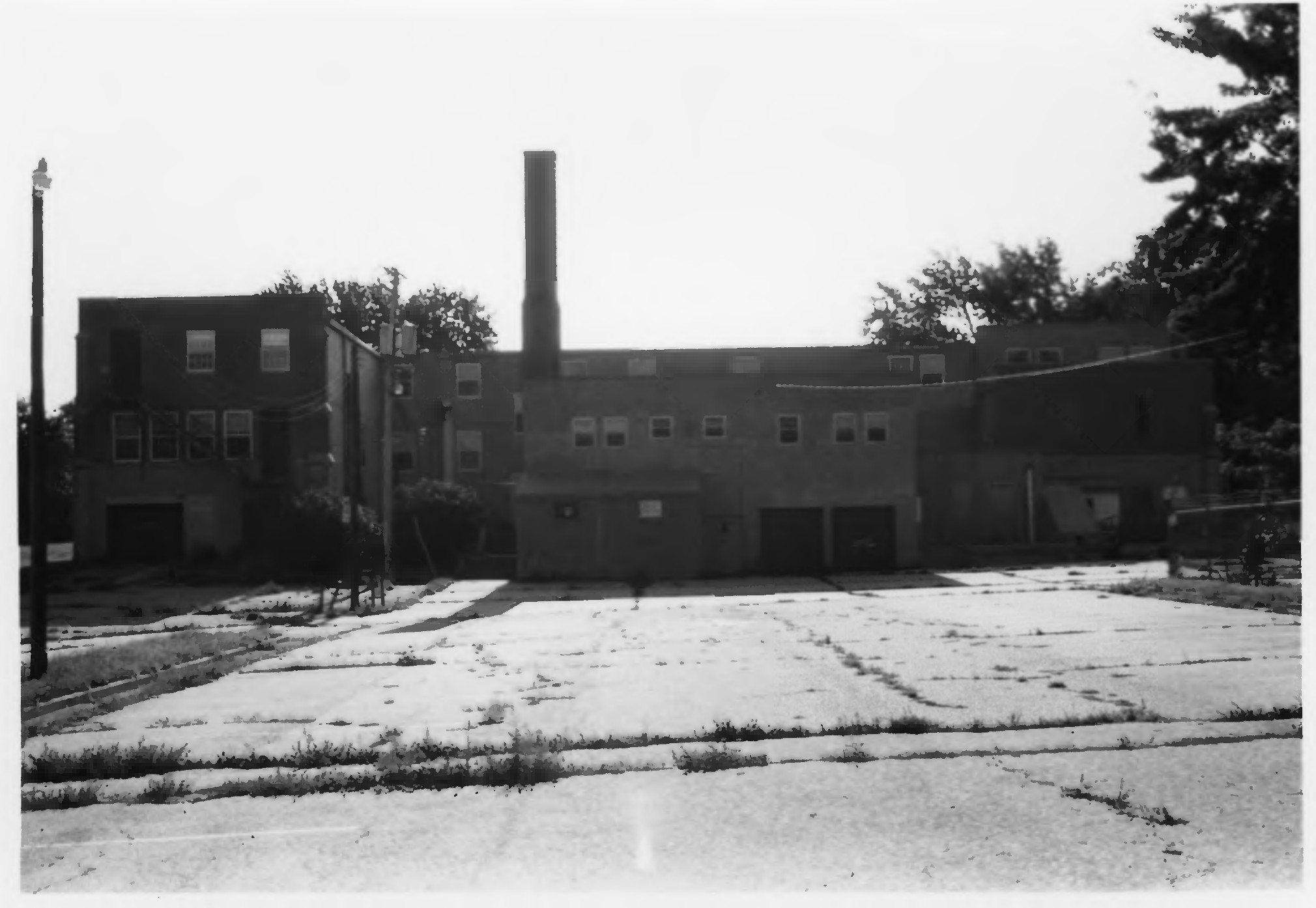
The west rear elevation in 1992
The west rear in 1992, with the brick stack and the cracked lot. Photograph submitted with the National Register of Historic Places nomination for the Presentation Children's Home, 1992; National Park Service, public domain.
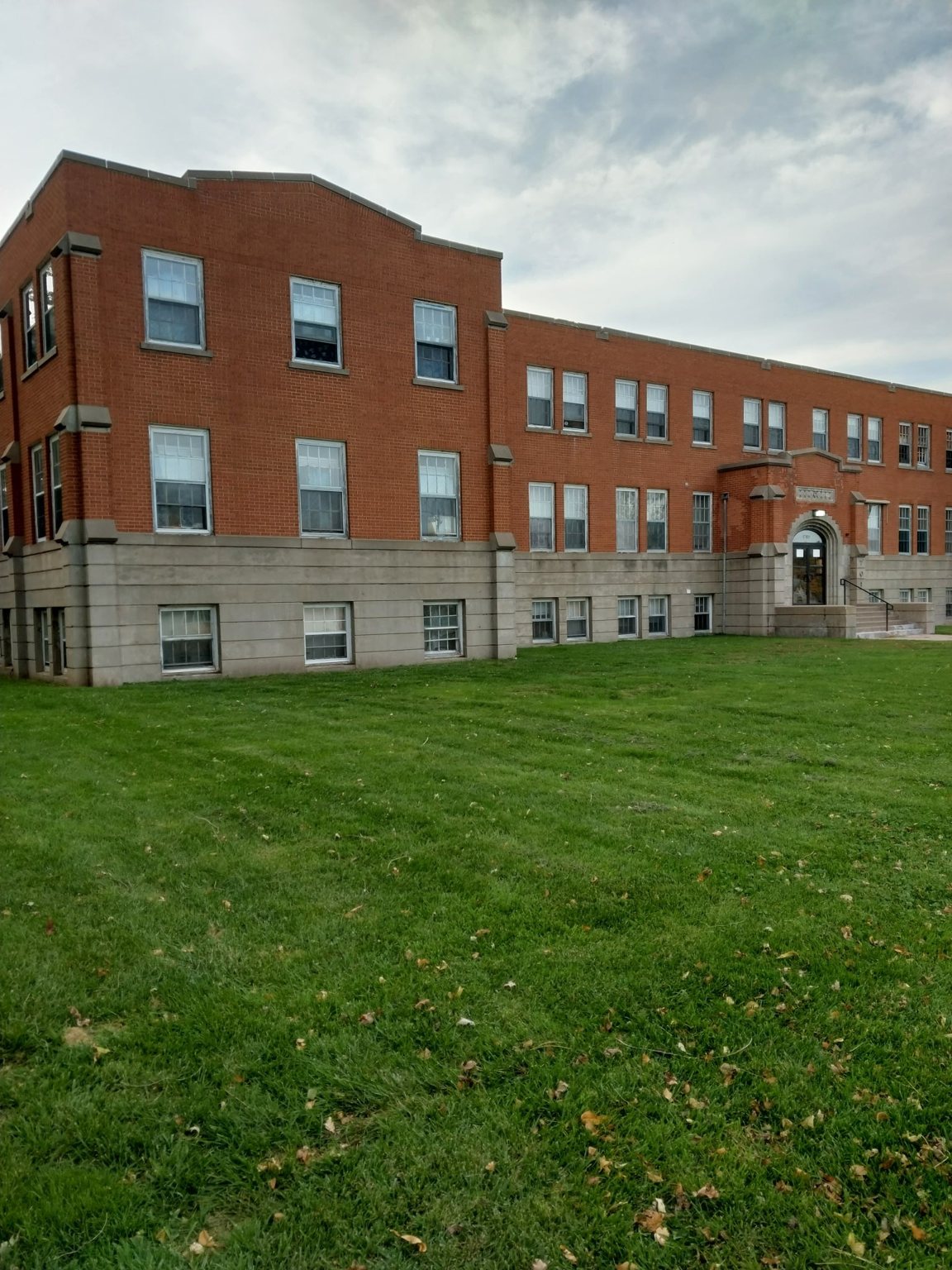
The building from the northeast in 2026
From the northeast, October 2026.

Five

Closed in 1966, and what the building did next.

The home closed because the idea behind it had been abandoned. Through the 1950s and 1960s the standard of care for dependent children moved from institutions to foster families, and an eighty-bed dormitory became the wrong answer to the question it had been built for. The Argus Leader reported the closing on 1 August 1966.

The building did not stand empty for long. In October the school board took it for classroom overflow; Southeastern Vocational Technical Institute followed and subdivided some rooms. By 1992 it was vacant and its owners had commissioned a feasibility study for a “West Campus Building” at Fifteenth and Western. The National Register nomination filed that June lists the building as vacant and cites, in its bibliography, a site plan for the Garfield Apartments. It was listed on the Register on 10 February 1993, and it is apartments now — twenty-six of them.

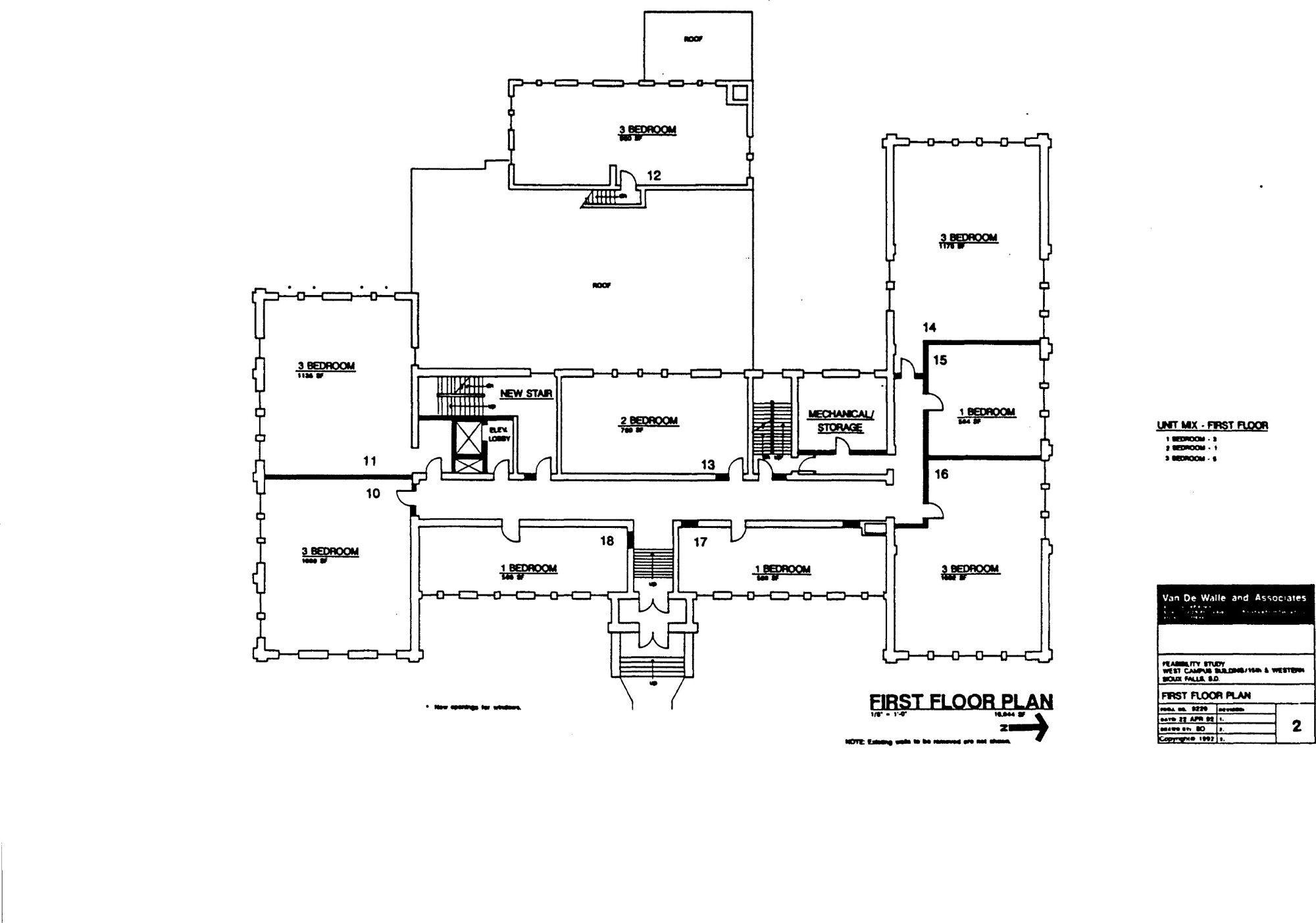
The drawings for that conversion were filed with the nomination, so the arithmetic of the change is on the record too. The unit mix proposed in April 1992 was ten one-bedroom apartments, three two-bedroom and thirteen three-bedroom: twenty-six in all, which is what the building is rented as today. The boiler room stays a boiler room. The chapel arm and the long classroom range become somebody's living rooms.

The 1992 first floor conversion plan for the building
First floor as redrawn for apartments, 22 April 1992. The H plan the 1992 survey described is the plan being carved up here: the long north-south range of classrooms, offices and bathrooms, and the two arms that held the big classroom and the chapel. Van De Walle and Associates, feasibility study for the West Campus Building, Fifteenth and Western, 22 April 1992, reproduced from the National Register file; public domain.

Six

Why this is on a McKennan Park site.

Because the same order is on both ends of it. The Presentation Sisters of Aberdeen are who ran McKennan Hospital, founded on the $25,000 Helen Gale McKennan left for a hospital in her 1906 will and dedicated on 17 December 1911, northeast of the park. The 1983 National Register nomination for the McKennan Park Historic District also lists the Presentation Sisters at 722 East 21st Street, on the park's own boulevard.

So the order that took the park donor's hospital bequest is the order that was sheltering sixty-odd orphaned children in borrowed rooms thirty years later, and the building it finally got stands a mile and a half northwest of the park. The marker in front of it comes from the same Minnehaha County Historical Society series as the three markers inside McKennan Park. Columbus College, named on side one as the place the children were housed from 1934, has its own marker half a mile away. So does E. A. Sherman, Helen McKennan's friend and executor, who handed the park to the city in 1908 — six tenths of a mile from where this marker stands.

One more coincidence of the survey grid, for anyone who has read the land: the children's home sits in section 19 of township 101 north, range 49 west. McKennan Park sits in section 21 of the same township. Two squares apart on the same sheet of paper, drawn by the same 1859 survey.

The entrance in October 2026
The entrance in October 2026, with the corner buttresses and the ornamental concrete surround the 1992 survey described. Somebody's front door now. Photographs of the Presentation Children's Home and its marker, 701 South Western Avenue, Sioux Falls, October 2026, taken for this site.

Seven

Dates.

  1. 1907

    The Little Flower Home opens at Turton, 160 miles north-northeast of Sioux Falls, serving the Diocese of Sioux Falls as both an orphanage and a parochial school. The marker in front of the building dates the orphanage to 1924; the National Register nomination gives 1907 to 1932.

  2. 21 March 1932

    Fire destroys the Turton home. Between 65 and 73 orphans are left homeless and 33 parochial students are left without a school, in the third year of the Depression.

  3. 1932 to 1934

    The children are moved to Graham Hall at Northern Normal College in Aberdeen for a short time, then to St. Joseph's School at Woonsocket for two years.

  4. Summer 1934

    The Columbus College building in Sioux Falls is offered to the Presentation Sisters. The children arrive by train and the Columbus Children's Home is established. It is overcrowded from the start.

  5. 7 March 1938

    Sister M. Francis writes to M. A. Kennedy, the state director of the Works Progress Administration. The order is looking for a way to build.

  6. 4 November 1938

    The Sioux Falls city commission adopts the first of five resolutions on the project, agreeing to act as sponsor so that federal labor can be used. The sisters engage Hugill & Blatherwick, who estimate the cost at $100,000.

  7. 1939

    Construction, by WPA labor on ground at Fifteenth and Western. The National Register gives 1939 as the year built and 1939 to 1942 as the period of significance.

  8. 1940

    The building opens. For the next twenty-six years voluntary donations let the sisters house, clothe, feed and school a daily average of eighty children aged three to fifteen.

  9. 1 August 1966

    The Argus Leader reports the home is closing. Public policy had shifted from institutional care to foster placement.

  10. 11 October 1966

    A month after closing, the paper reports the building will serve as a training site. The school board uses it for classroom overflow; Southeastern Vocational Technical Institute follows and subdivides some rooms.

  11. 22 April 1992

    A feasibility study for the “West Campus Building, 15th and Western” is prepared for the owners. The National Register nomination, filed that June, lists the building as vacant and cites a site plan for the Garfield Apartments.

  12. 10 February 1993

    The Presentation Children's Home is listed on the National Register of Historic Places, reference 92001852.

  13. 2005

    The Minnehaha County Historical Society dedicates the marker that stands at the sidewalk, in honor of Cody Huber.

  14. Today

    Twenty-six apartments. The building is private housing; the marker is on the public walk.

Eight

Sources.

  • Presentation Children's Home, National Register of Historic Places registration form, reference 92001852, prepared by Rolene R. Schliesman, 30 June 1992, listed 10 February 1993 — the Turton fire and its date, the eight years of temporary quarters, the city's sponsorship, the architects and the cost estimate, the building description, and the bibliography of city commission resolutions and Argus Leader clippings cited below.
  • Presentation Children's Home marker, erected 2005 by the Minnehaha County Historical Society in honor of Cody Huber, 701 South Western Avenue; both faces transcribed in full above.
  • City of Sioux Falls commission minutes and resolutions, Book 16 p. 494 (4 November 1938) and Book 17 pp. 23-24, 72, 169 and 186 (6 November 1939 to 13 September 1940), cited in the nomination.
  • Argus Leader, “Homeless Find Home in City's 2 Institutions,” 20 June 1956; “Presentation Children's Home Closing,” 1 August 1966; Wally Lutz, “Presentation Children's Home Use Undetermined,” 13 September 1966, and “Presentation Home to Serve as Training Site,” 11 October 1966 — cited in the nomination from the Sioux Falls Public Library clipping files. The paper itself is not digitized for these years.
  • Sister Agnes Dangel, “A History of the Work of the Presentation Sisters in the Care of Homeless Children,” Presentation Heights Archives, Aberdeen, May 1980; and Susan Carol Peterson and Courtney Ann Vaughn-Roberson, Women With Vision: The Presentation Sisters of South Dakota, 1880-1985 (University of Illinois Press, 1988), pp. 104-105 and 242 — both cited in the nomination.
  • McKennan Park Historic District, National Register nomination, reference 84003359 (1983) — McKennan Hospital under the Presentation Sisters of Aberdeen, and the Presentation Sisters at 722 East 21st Street inside the district.
  • Historical Marker Database entry 207156 for the marker's location, 43° 32.387′ N, 96° 45.079′ W, and for the neighboring markers.