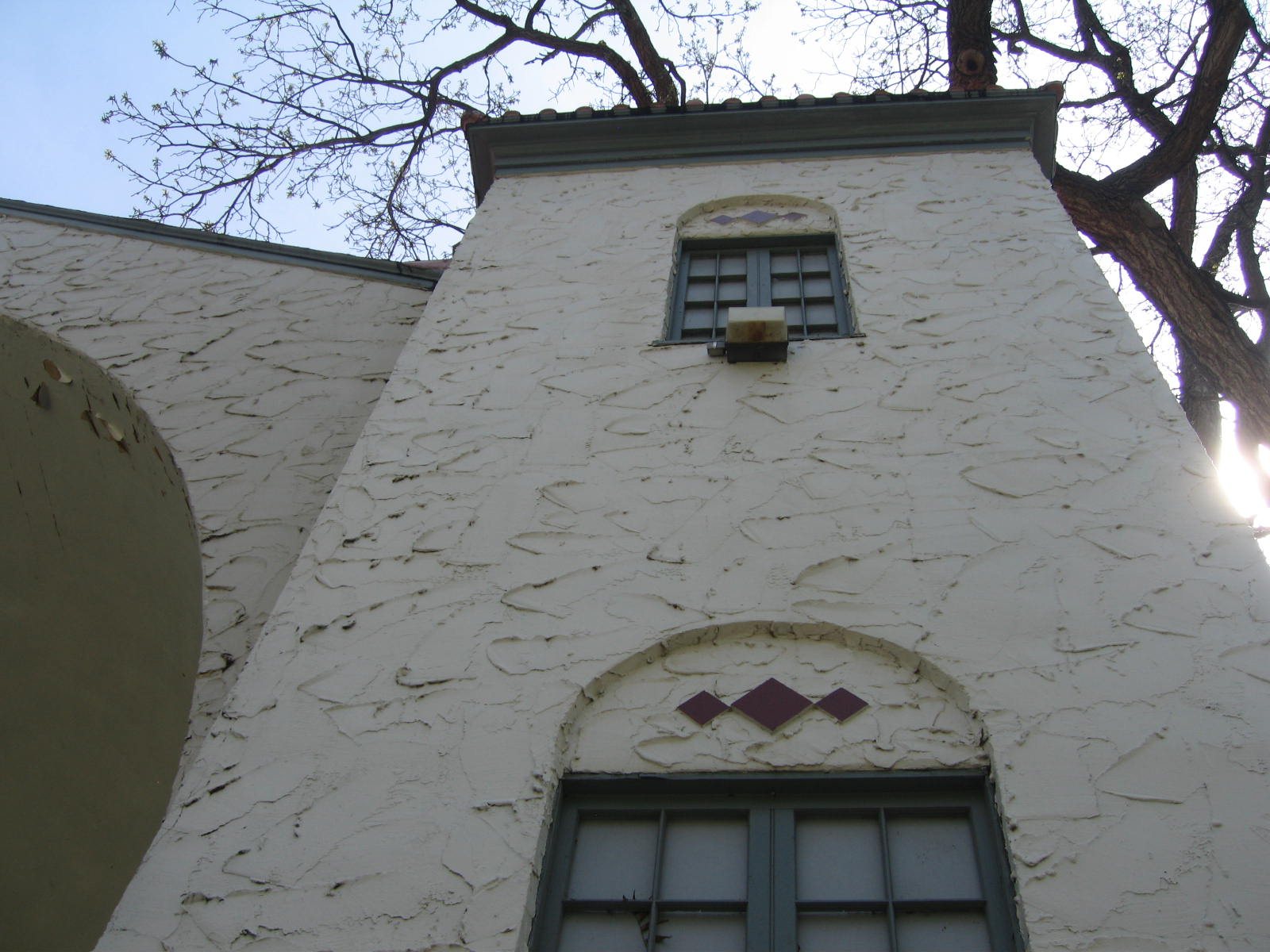
Band shell tower detail

Landmarks

Eight things worth walking to.

Each has a date, a donor and a story. Seven have bronze markers.

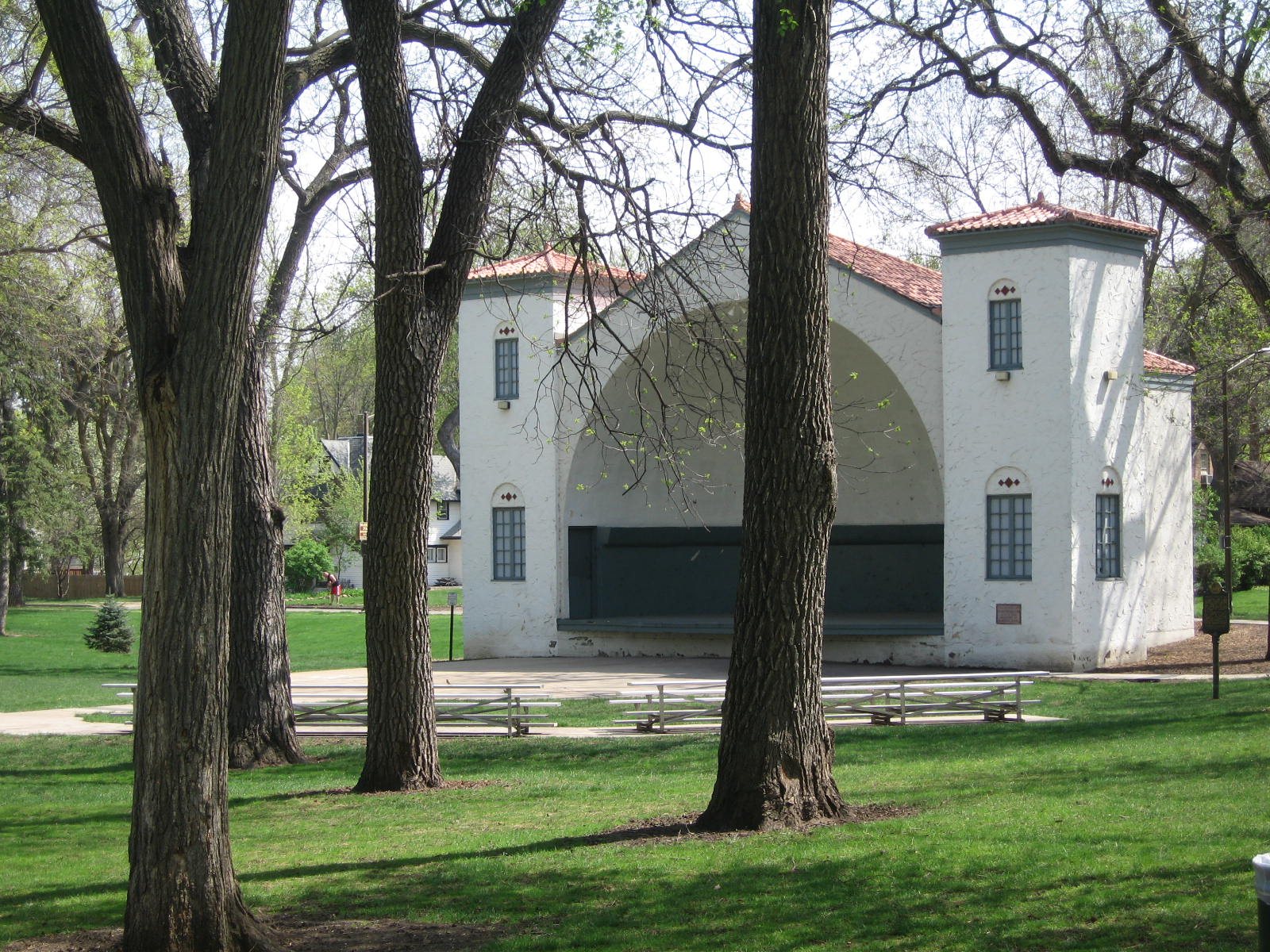
The stucco band shell with red tile roof and two square towers
Photograph by Missy Kitzman, Sioux Falls, 2010, CC BY 2.0, via Wikimedia Commons

01 · 1926

The band shell

The Sioux Falls Municipal Band took the idea to the Cosmopolitan Club, and the club built the shell as a gift to the city. It was dedicated on the evening of July 4, 1926, the 150th anniversary of the Declaration of Independence, before a crowd reported at ten thousand.

Textured stucco, two small square towers and a red tile roof give it what the National Register nomination calls a Mediterranean flavor, a vocabulary the sunken garden shares. It was renovated in 1995 and again for its centennial in 2025, with a new stage surface, drainage and lighting. Every summer Monday it fills the lawn with free concerts.

Its own page
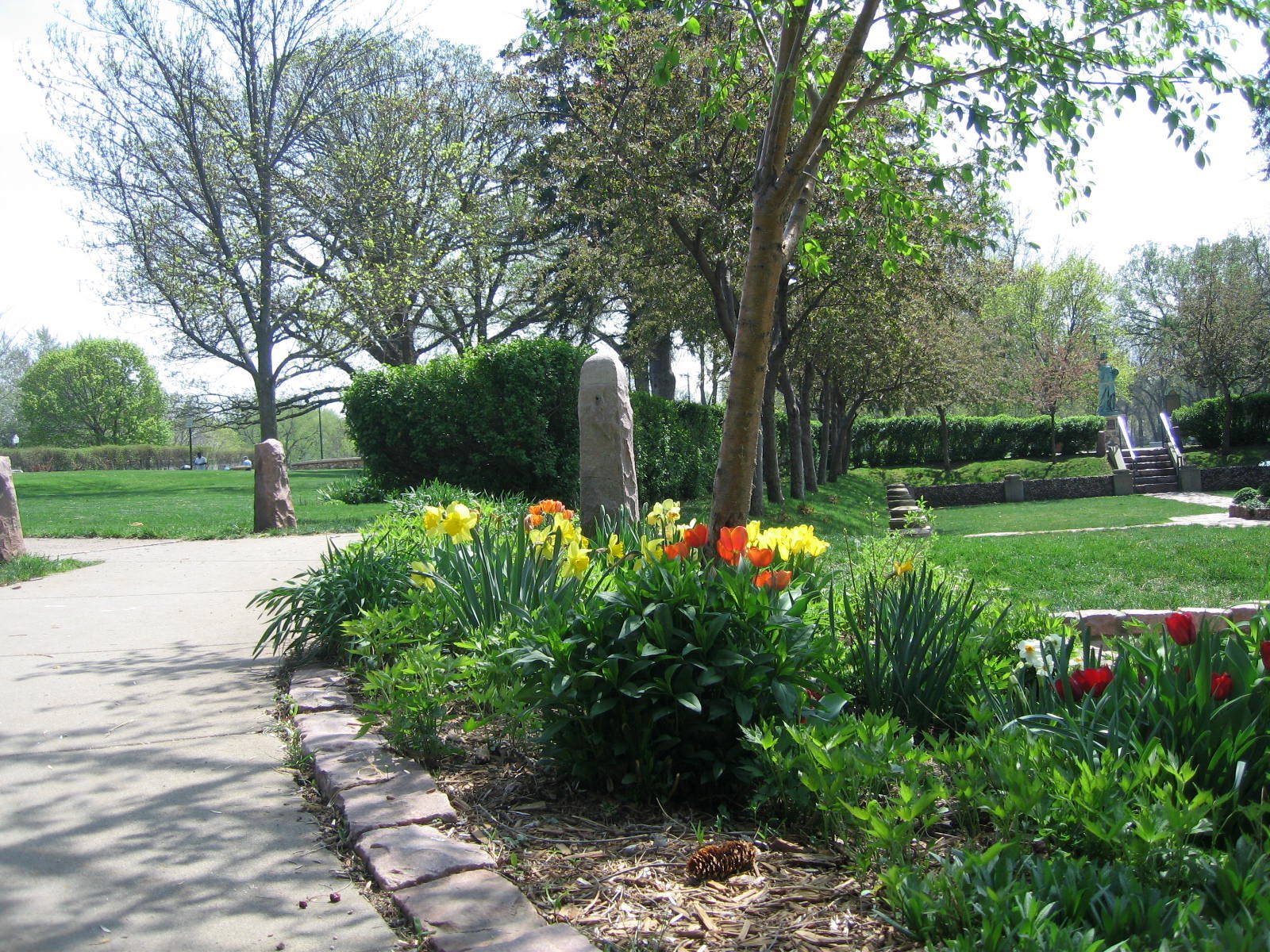
Tulip beds and formal plantings in the sunken garden
Photograph by Missy Kitzman, Sioux Falls, 2010, CC BY 2.0, via Wikimedia Commons

02 · 1920s

The sunken garden

A stone-walled formal garden below the band shell, planted each year in annuals around a small fountain. The 1984 nomination called it a sunken Roman garden; the city calls it the Mediterranean Sunken Garden. Postcard publishers sold it for decades.

It was remodeled in 1996 and is the park's wedding venue. The city books ceremonies through Parks and Recreation.

Its own page
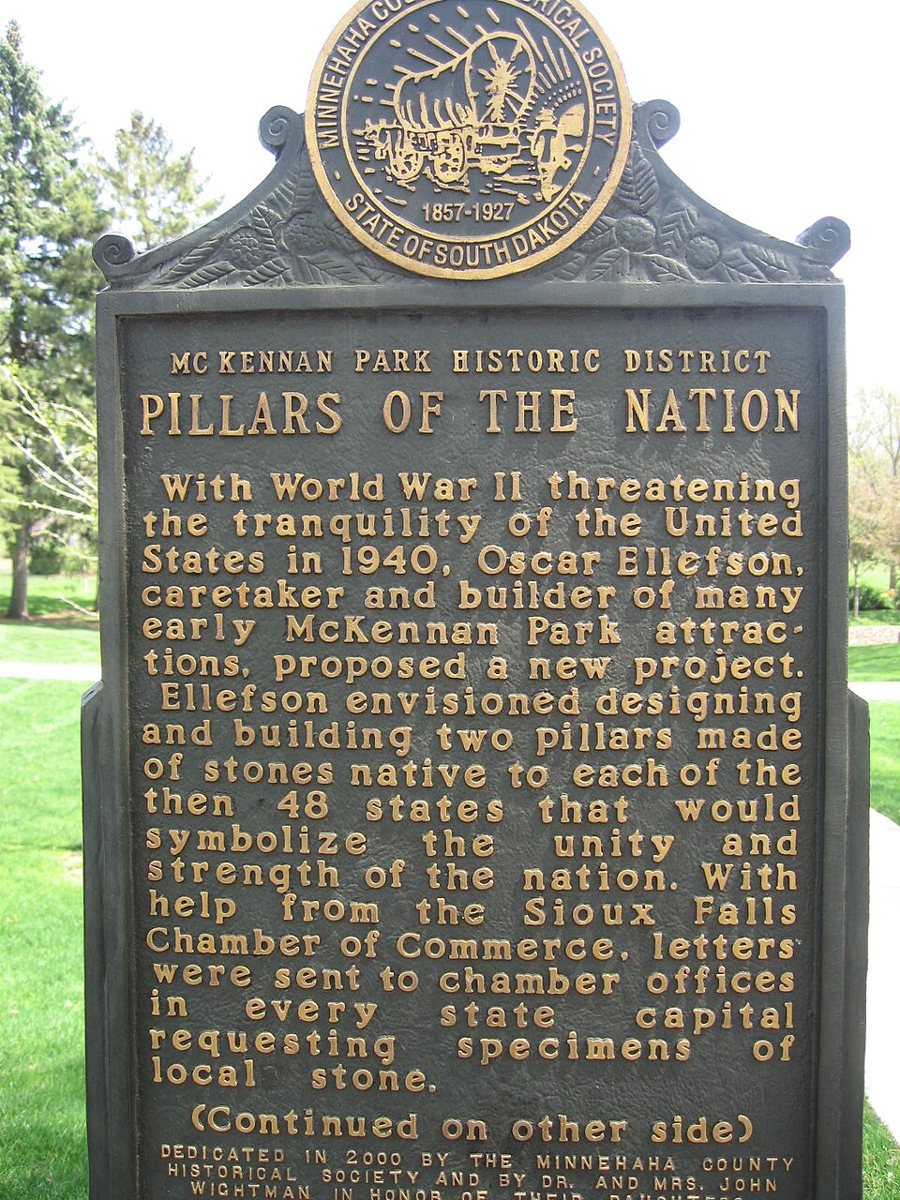
The Pillars of the Nation sign and stone pillars at the park entrance
Photograph by Missy Kitzman, Sioux Falls, 2010, CC BY 2.0, via Wikimedia Commons

03 · 1941

Pillars of the Nation

In 1940, with war threatening, park caretaker Oscar Ellefson, who had built many of the park's early attractions, proposed two pillars made of stone native to each of the forty-eight states, to stand for the unity and strength of the nation. The Chamber of Commerce wrote to its counterpart in every state capital asking for specimens, and every state sent one. The pillars were finished in August 1941 and named the Pillars of the Nation.

They joined two older pillars built of South Dakota stone, fossils and Native artifacts donated by Emil M. Christianson of Hills, Minnesota. Alaska and Hawaii, admitted in 1959, are not represented. Parks and Recreation refurbished all four in 1999 and lit the South Dakota pair.

Its own page
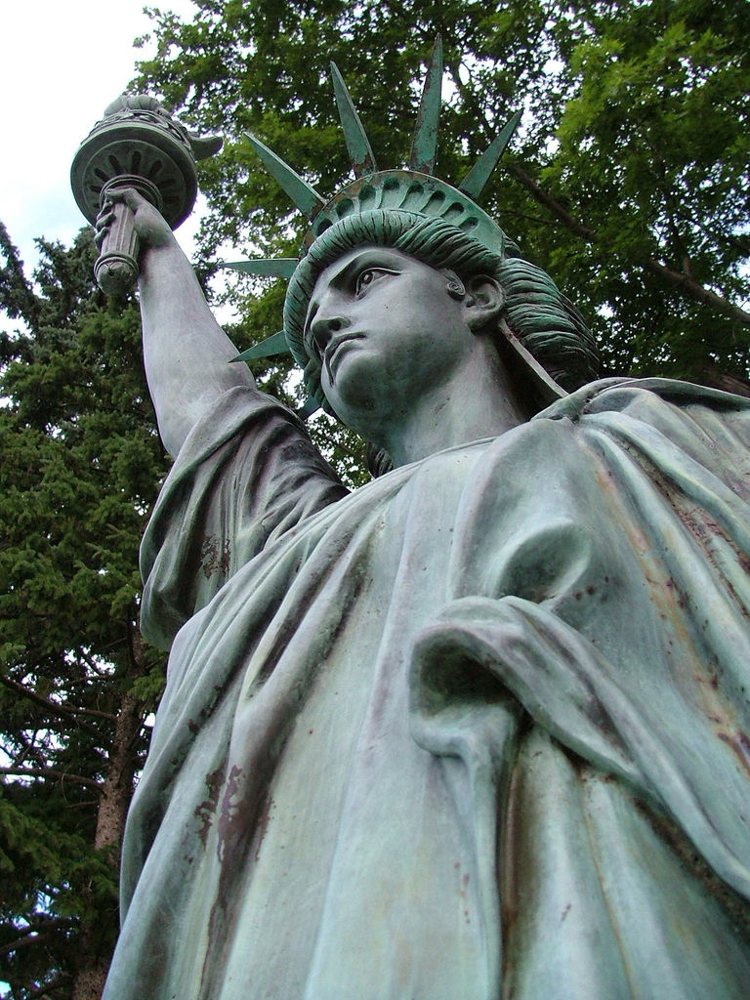
The bronze Statue of Liberty replica on its stone pedestal
Photograph by Jerry Fisher, 2005, public domain, via Wikimedia Commons

04 · 1943 and 2002

Lady Liberty

Pioneer Charles A. Sells owned a wooden Liberty he said Bartholdi had carved as a working model. The Sioux Falls Garden Club raised the money to buy it, and on August 1, 1943, twins Thelma and Elma Iverson unveiled it before several thousand people. During the war it was where servicemen stationed in the city brought their sweethearts on moonlit nights.

Vandals ruined the wooden figure in the 1960s. On July 22, 2002, a bronze Liberty Enlightening the World by sculptor Serguei Iourov was dedicated on the restored fieldstone pedestal.

Its own page
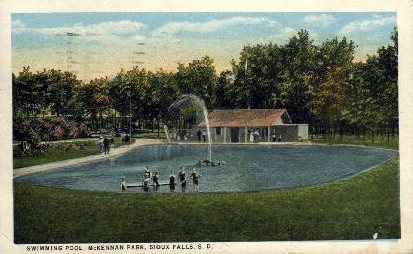
Postcard of the 1929 wading pool with its fountain and bath house
Linen-era postcard, about 1930 to 1950, publisher unknown

05 · 1908, 1929, 1971, 2026

The wading pool

E. A. Sherman dammed a small lake in 1908 that children used as a swimming hole. A permanent concrete pool with a fountain replaced it in 1929, southwest of the sunken garden, and a new pool followed in 1971 after neighbors blocked plans for a full-size swimming pool.

The current pool opened May 29, 2026: zero-depth entry to a two-foot maximum, a two-person slide, spray features and a rebuilt bathhouse with concessions and an indoor room. Admission has been free since 1929 and still is.

Its own page
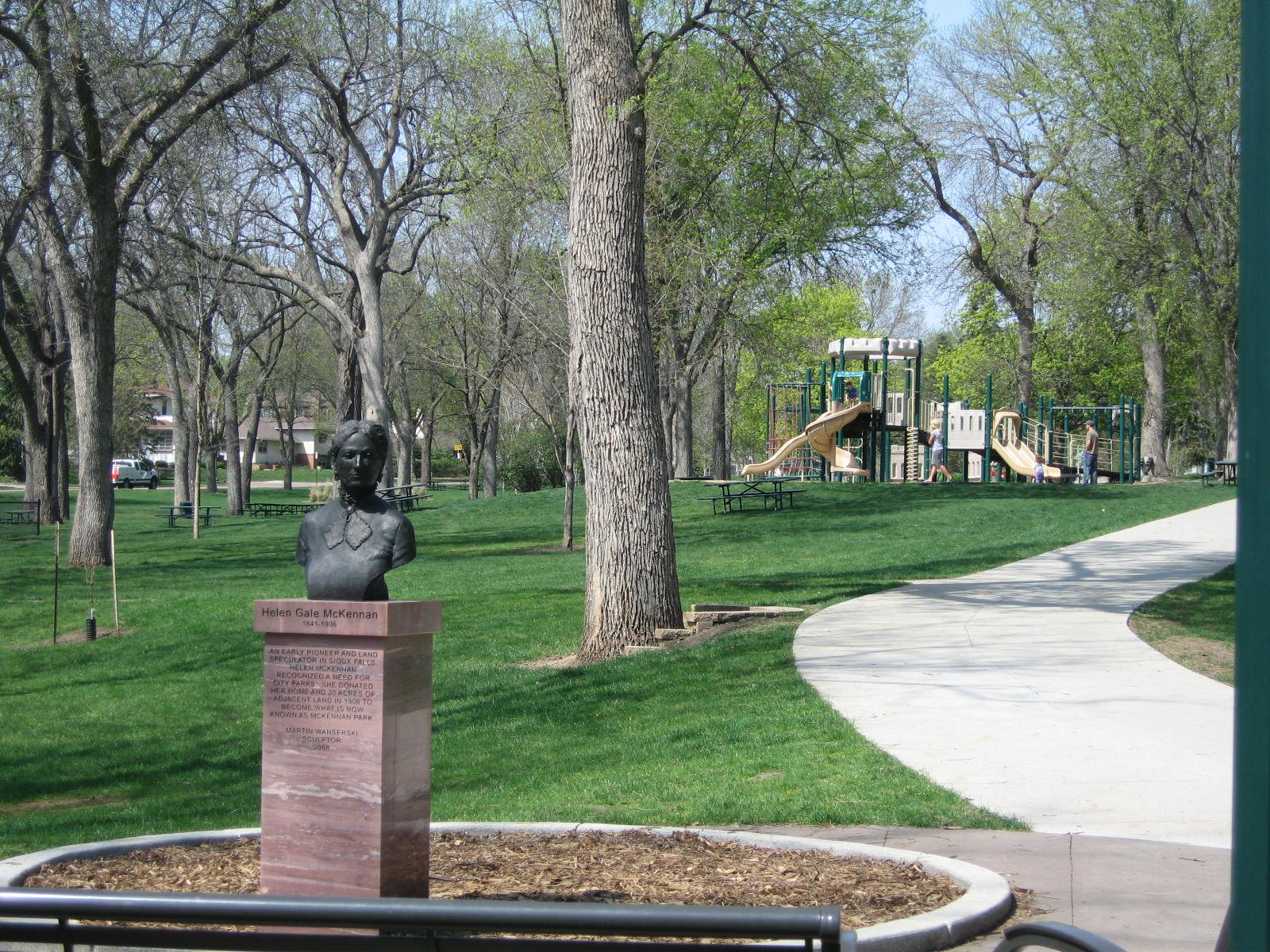
Bronze bust of Helen Gale McKennan on a red stone pedestal with the playground behind
Photograph by Missy Kitzman, Sioux Falls, 2010, CC BY 2.0, via Wikimedia Commons

06 · 2008

Helen Gale McKennan

A bronze bust by Martin Wanserski, placed for the park's centennial in 2008, stands near the playground. Its inscription calls her an early pioneer and land speculator who recognized a need for city parks and gave her home and twenty acres in 1906.

She was born in Albion, New York, in 1841, came west as a widow, and became one of the wealthiest women in Sioux Falls. Her will also founded McKennan Hospital.

Its own page
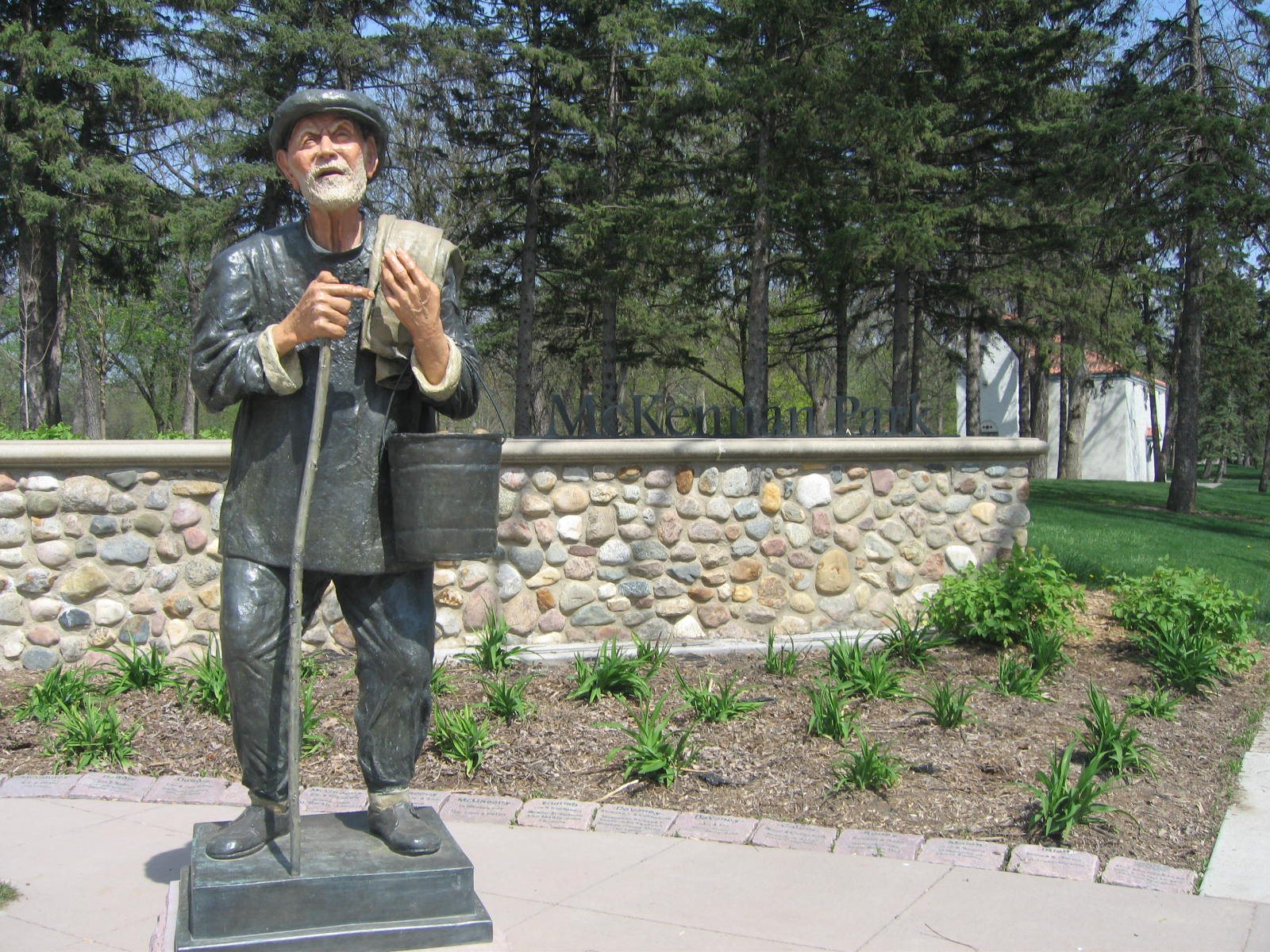
Bronze sculpture of a farmer holding a potato, beside a stone wall
Photograph by Missy Kitzman, Sioux Falls, 2010, CC BY 2.0, via Wikimedia Commons

07 · 2008

Potato Man

A bronze farmer from the 2006 Sioux Falls SculptureWalk, bought for the park and installed in the southwest corner for the 2008 centennial. He has become the park's unofficial greeter.

Its own page
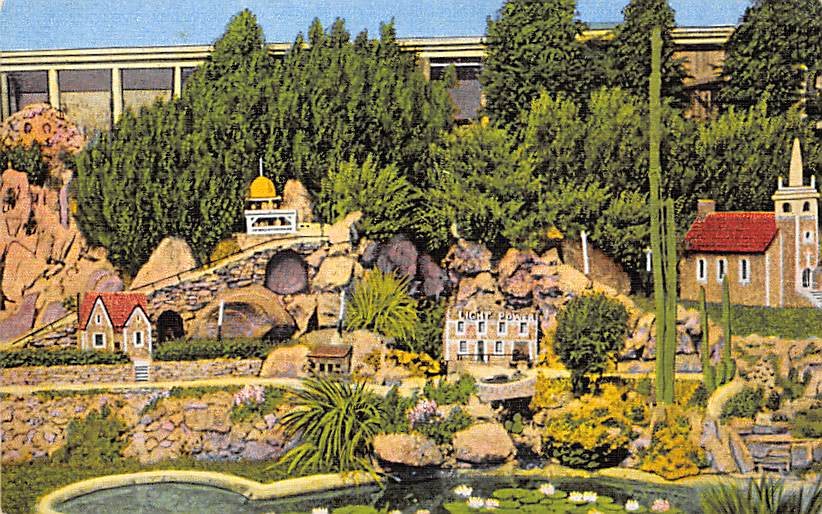
Postcard of the Miniature Village: small houses, a church, a Light and Power building and a lily pond
Linen-era postcard, about 1930 to 1950, publisher unknown

08 · 1931 to 1961, lost

The Miniature Village

Park employees built a miniature rock garden and town in 1931 northeast of the formal gardens, beside the greenhouses: little houses, a church, Light and Power buildings, a model railroad that ran on certain days, a water wheel and a goldfish pond with a tiny fisherman. A cactus garden and a miniature mountain scene with its own powerhouse stood nearby.

Vandalism forced its removal in 1961. A marker near the site records it, and people who grew up here still describe pulling themselves up on the garden wall to look at the church.

Its own page

The seven markers, read in full.

Historical markers