

There was a choice. The work in McKennan Park this autumn was ordinary: a new irrigation system went in under the lawns, the trenches were backfilled, and the bare strips of soil needed grass. Every park department in the country does this job, and the turf research has settled how. Grass can be laid as sod. Seed can be cut into the soil, drilled, or dropped and raked in, then covered with hay, a blanket or compost. Each of those methods places the material on the ground or presses it into the soil, and none of them puts anything into the air that a person walking by would breathe.
The method chosen was the one that does. Between 12 and 20 October the strips were hydroseeded: a slurry of seed, fiber, dye, fertilizer and binder was pumped through a hose and thrown across them, on days when the wind at the park reached 16 to 21 miles an hour, in a park that stayed open, with no notice to the homes around it. Hydroseeding has a real purpose. It reaches ground no person or machine can work, the steep cuts and embankments along highways. McKennan Park’s lawns are not that ground.
Seven methods. One sprays.
These are the standard ways to regrass a trench, as university extension services, state highway departments and the city’s own standards describe them. The question that separates them is simple: how does the material reach the ground?
- 1SodLaid by hand, roll by rollA slab of living turfNothing
- 2Slit seedingDropped into a groove cut in the soilA seed, 2.4 to 3.1 mmNothing
- 3Drill seedingPlaced 6 to 12 mm deep behind a diskA seed, 2.4 to 3.1 mmNothing
- 4Drop spreader, rake and rollFalls a few inches from the hopper, then raked inA seed, 2.4 to 3.1 mmNothing
- 5Crimped hayLaid on the soil and pressed 4 inches inFibers 10 inches and longerChaff, if blown by machine
- 6Seed blanketsUnrolled and stapled to the groundA woven matNothing
- 7Compost blanketSpread by loader and rakeCrumbs of compostDust, if blown by machine
Seven methods lay the material down. One throws it up. That difference is not a matter of degree. It is the difference between a seed that lands where it is dropped and a mist that goes where the air goes.
What a spray makes that a seed does not
A Kentucky bluegrass seed is 2.4 to 3.1 millimetres long, by measurements of named cultivars at the University of Nebraska, and there are about 2,177,000 of them in a pound, by Purdue’s count. Each weighs about a fifth of a milligram. Dropped from a spreader a few inches above the soil, it lands within inches of where it fell. Laid by hand as sod, or pinned down as a blanket, the material never leaves the ground at all.
A spray is different in kind. When a liquid is forced through a nozzle, the jet tears apart into droplets of every size at once, from drops as wide as a seed down to particles finer than fog. The smallest are the ones that matter. A droplet 50 micrometres across, half the width of a hair, weighs about three thousand times less than a bluegrass seed; a 10-micrometre droplet weighs about four hundred thousand times less. Air resistance, not gravity, decides their path. Spray science treats droplets under about 150 micrometres as the drift-prone fraction, the share the wind carries away from where it was aimed.
The numbers add up quickly. No one has published a measured droplet spectrum for a hydroseeder, so any count rests on an assumption. Taking the spectrum used in the drift model built for this article, with half the volume in droplets larger than 500 micrometres, a single gallon of slurry breaks into roughly 3.7 billion droplets between 10 and 150 micrometres, the drift-prone range. A hydroseeding job runs to hundreds of gallons. Some of those droplets land on the trench. Some land on the lawn, the path, the street. The finest dry out in flight to cores of fiber, dye, fertilizer salt and binder, small enough to be breathed in, and keep moving.
The physics of drift is not exotic. A droplet released at head height in a 10 mile-an-hour wind travels about 81 feet before landing if it is 100 micrometres across, 293 feet at 50, and more than a mile at 10, by Stokes’ law and the measured fall speeds of water drops. At the 16 to 21 miles an hour of the windiest hours that week, every one of those distances grows by 60 to 110 percent. No seed does that. No roll of sod does that. Only a spray does.
Seven methods lay the material down. One throws it into the air.
You cannot see where it went
This is the whole point, and it is the part that is easiest to miss. Look at the trenches and the spray appears to have stayed exactly where it was aimed: neat green strips, crisp edges, untouched grass on either side. That picture is true of the drops you can see. It says nothing about the ones you cannot.
The human eye has a limit. Estimates for the smallest object a healthy eye can make out run from 20 to 100 micrometres, and most people can distinguish things down to about 70, the width of a single hair, according to the particle-science lecture notes Penn State uses to teach air-pollution engineering. A single droplet smaller than that, drifting in daylight, is invisible. Only a dense cloud of them shows, as a faint haze, and a haze thins to nothing within a few yards of the nozzle. The drift-prone fraction of a spray, everything under about 150 micrometres, lies mostly below that limit. The droplets that travel are, almost by definition, the droplets no one sees travel.
The dye makes this worse, not better. Hydroseed is colored green so the operator can see where coverage is complete. The green marks the ground where enough slurry landed to stain it, which means where the large drops fell. A mist of fine droplets spread over a lawn, a path, a car, a porch or a person leaves too little dye in any one place to show. So the strip is a map of where the heavy part of the spray landed. It is not a map of where the spray went.
The figure shows why. In the wind of 16 October, the large drops, 300 micrometres and up, land within about twenty-five feet, on or beside the strip; that is the green you see. Drops of 120 micrometres, near the edge of what an eye can make out, already landed 20 to 170 feet away, and one was still airborne when it left the figure. The small ones behave like smoke. Air near the ground does not flow in a smooth sheet; it rolls in eddies, from gusts the size of the park down to swirls smaller than a hand, and each eddy carries whatever is light enough to follow it. Droplets of 15 to 60 micrometres were lifted to fifty, a hundred, two hundred feet, above the tree canopy, and carried past nine hundred feet before the computation stopped following them. On the way they shrink. Water evaporates from each droplet in flight, and what is left is a dry core of fiber, dye, fertilizer salt and binder that falls even more slowly than the droplet did.
Agricultural agencies teach the same physics to pesticide applicators. Ontario’s Ministry of Agriculture notes that a 100-micrometre droplet “takes 11 seconds to fall 3 metres in still air and will drift more than 20 metres in an 8 km/h wind,” a wind of five miles an hour. The wind at McKennan Park on 16 October was more than three times that. The same ministry adds that vapour drift, the gas that rises from spray as it dries, “is invisible.” Ammonia from a urea fertilizer is exactly that kind of vapour.
The green shows where the spray landed. It cannot show where the spray went.
Nothing about this is particular to hydroseed. It is true of any liquid broken into a fine spray outdoors, which is why pesticide labels carry wind limits and why spray drift is studied at all. What is particular to McKennan Park is the setting: the strips run beside the paths and the playground, across the lawn from the houses on every side, in a park that stayed open, on days when the wind gusted past forty miles an hour. Seven other methods would have put grass on the same strips without making a single droplet.
What the city’s own rules say
The case against spraying level lawn does not have to come from outside. It is written in the city’s own standards, ordinances and contract terms. Chapter 12 of the Sioux Falls Engineering Design Standards sets the erosion-control requirements for disturbed ground, utility trenches included, and its default is seed drilled into the soil under long-stemmed hay crimped in place. Hydraulic methods are the exception, for slopes steeper than 3:1, a rise of one foot in three, or ground that cannot be reached. The Code of Ordinances makes those standards binding on development sites. The General Conditions the city writes into its construction contracts require the contractor to keep a project secured from public use, to provide for the safety of the residents along it, and to prevent pollution of the atmosphere. The nuisance ordinance reaches anything that makes “the air” a hazard to health, or annoys or endangers the health or comfort of others.
“Hydraulic seeding may be substituted for drilling only where slopes are steeper than 3:1 or where access limitations exist.”
City of Sioux Falls, Engineering Design Standards, Table 12.3
| Rule | What it says | Source |
|---|---|---|
| Engineering Design Standards, §12.2.2 | “Hydraulic mulching shall be limited to those situations where it is too difficult to apply and anchor a mulch of long-stemmed grass hay or cereal straw; namely, slopes steeper than 3:1 or where access is limited.” | City of Sioux Falls, Ch. 12, rev. 2023 |
| Engineering Design Standards, Table 12.3 | “Hydraulic seeding may be substituted for drilling only where slopes are steeper than 3:1 or where access limitations exist. When hydraulic seeding is used, hydraulic mulching shall be done as a separate operation.” | City of Sioux Falls, Ch. 12, rev. 2023 |
| Engineering Design Standards, §12.2.2 | Hay is preferred to straw “as it is less susceptible to removal by wind,” and spraying a tackifier is satisfactory only “on small areas sheltered from the wind.” | City of Sioux Falls, Ch. 12, rev. 2023 |
| Code of Ordinances §157.175 | “Measures used to control erosion on a development site shall meet the requirements of the engineering design standards.” §157.176 adds that land disturbance of an acre or more “shall comply with chapter 12.” | Sioux Falls Code of Ordinances |
| General Conditions §4.5 | “Unless otherwise provided, the Contractor shall keep the project secured from public use. Such measures to adequately restrict public access must be used and maintained by the Contractor.” | General Conditions for Public Improvements, 2024 |
| General Conditions §7.7 | “The safety and convenience of the general public, the residents along the project, and the protection of persons and property shall be provided for by the Contractor.” The contractor “shall be required to control dust which causes a hazard or nuisance.” | General Conditions for Public Improvements, 2024 |
| General Conditions §7.10 | “The Contractor shall take all necessary precautions for the protection of the work and safety of the public.” | General Conditions for Public Improvements, 2024 |
| General Conditions §7.21 | “Necessary precautions shall be taken … to prevent pollution of the atmosphere.” | General Conditions for Public Improvements, 2024 |
| Code of Ordinances §92.070–92.071 | “No person shall create, commit, maintain or permit … any nuisance within the city.” A nuisance includes “whatever renders the ground, the water, the air, or food a hazard or an injury to human health, or whatever annoys, injures, or endangers the health, comfort, or safety of others.” | Sioux Falls Code of Ordinances |
| Code of Ordinances §95.005 | “No person shall go on foot or otherwise upon the grass or turf of any park or parkway where any prohibitory sign is posted.” | Sioux Falls Code of Ordinances |
| Code of Ordinances §95.032 | The director may close parts of a park where conduct is “dangerous,” and “a notice prohibiting activity within a specific area shall be conspicuously displayed.” | Sioux Falls Code of Ordinances |
| SDDOT Specifications §730.3, §732.3 | “Seed will not be sown when the wind interferes with uniform seed application.” Mulching “will not be performed during periods of high winds.” The city’s General Conditions, §5.4, make these specifications part of its contracts. | South Dakota DOT, Standard Specifications |
Each of those rules bears on what happened in October. McKennan Park’s lawns are close to level, and a crew that could drive a hydroseeding truck to the trenches could have reached them with a seeder, a spreader or a pallet of sod. The park stayed open while the work went on; KELOLAND reported caution tape around the irrigation work zones in September, but the photographs of the sprayed strips on 21 October show no tape and no sign. No prohibitory sign was posted on the strips, and under §95.005 a sign is the very thing that makes walking on new turf an offense. The parks director holds the power, under §95.032, to close a dangerous area with a conspicuous notice. The wind on four of the spraying days reached 16 to 21 miles an hour in its strongest hour.
Two limits belong beside this. The specifications for this project, bid 26-1045, sit behind a supplier login and are not public, so whether they adopted the design standard, modified the General Conditions or allowed hydroseeding by name cannot yet be checked. And whether any of it amounts to a violation is a judgment for the city, and if it comes to that, for a court. What the record shows is narrower and harder to dispute: the city’s own rules prefer methods that keep the material on the ground, and those methods were available.
One more line in the code is worth reading. The only place the Sioux Falls Code of Ordinances mentions the city’s own spraying is §90.107, adopted in 2019: “The city is not liable for any damage to honeybees, hives, colonies, or hobby beekeeping operations resulting from the city’s use of spray to kill pests or weeds on public rights-of-way or public property.” The code protects the city from beekeepers. It says nothing about warning the people who live beside the property being sprayed.
One: sod
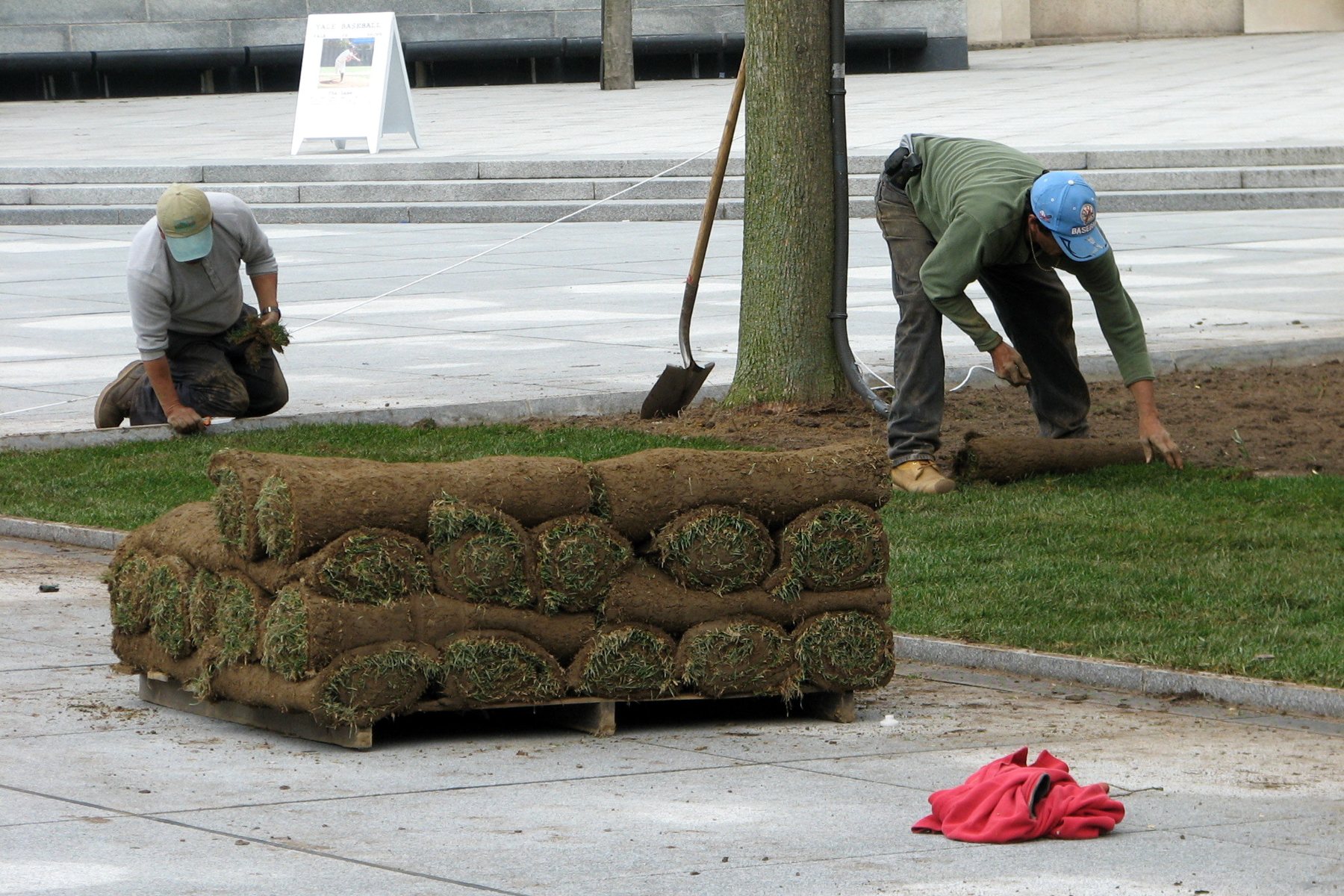
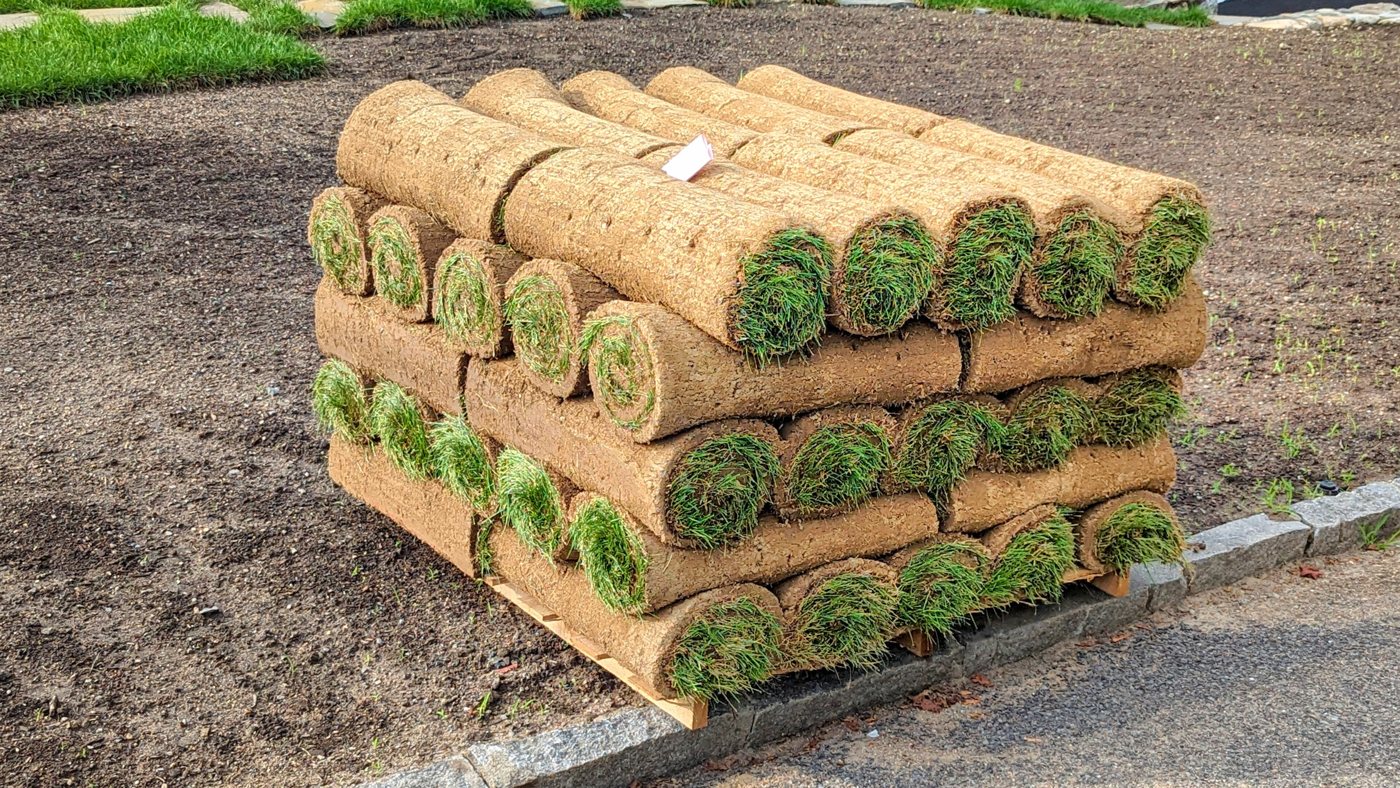
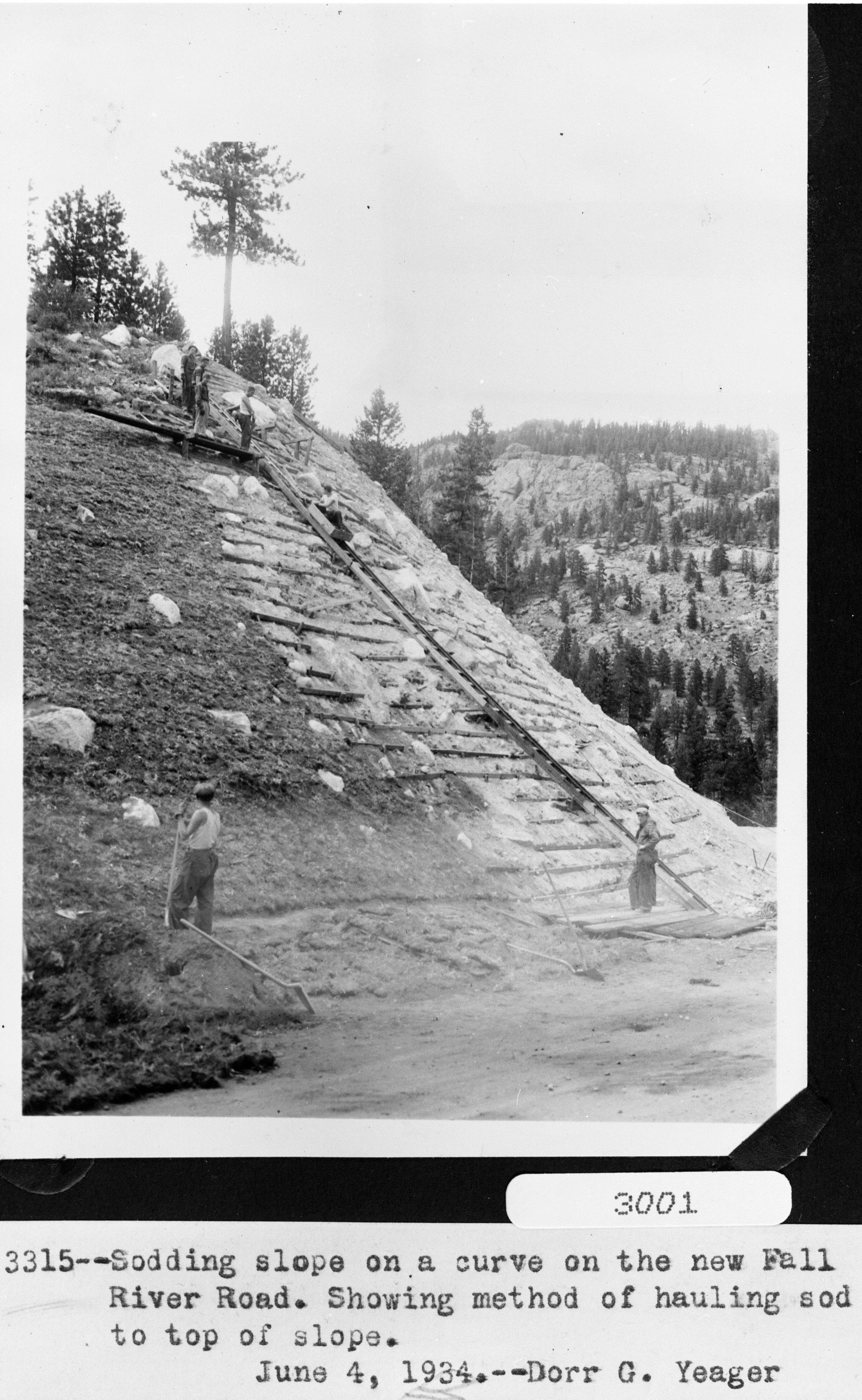
Sod is grass grown to maturity on a farm, cut with an inch of soil and rolled. It is the oldest answer to a strip of bare ground, and the most direct one: the strip is covered the day the work is done, and nothing leaves the ground in the doing. Narrow trenches are close to the ideal case, because a roll is already the shape of the job. University of Minnesota Extension rates sod above seed wherever erosion is a concern, and in the upper Midwest almost all of it is Kentucky bluegrass, the backbone of a park lawn.
It can be laid any time the ground is not frozen, and early fall is the best of it. Extension guidance from Nebraska and Minnesota asks for sod laid within a day of cutting, in a brick pattern with tight seams, rolled lightly and watered daily for two weeks. In good weather it roots in ten to fourteen days. Late October roots more slowly, and the long edges of a narrow strip dry first and need the closest watching.
The costs are money and water. Sod runs about five times the price of hydroseeding by the square foot and needs a hose every day for two weeks. Against that, the job is finished when the crew leaves, and the neighbors breathe nothing of it.
Two and three: slit and drill seeding
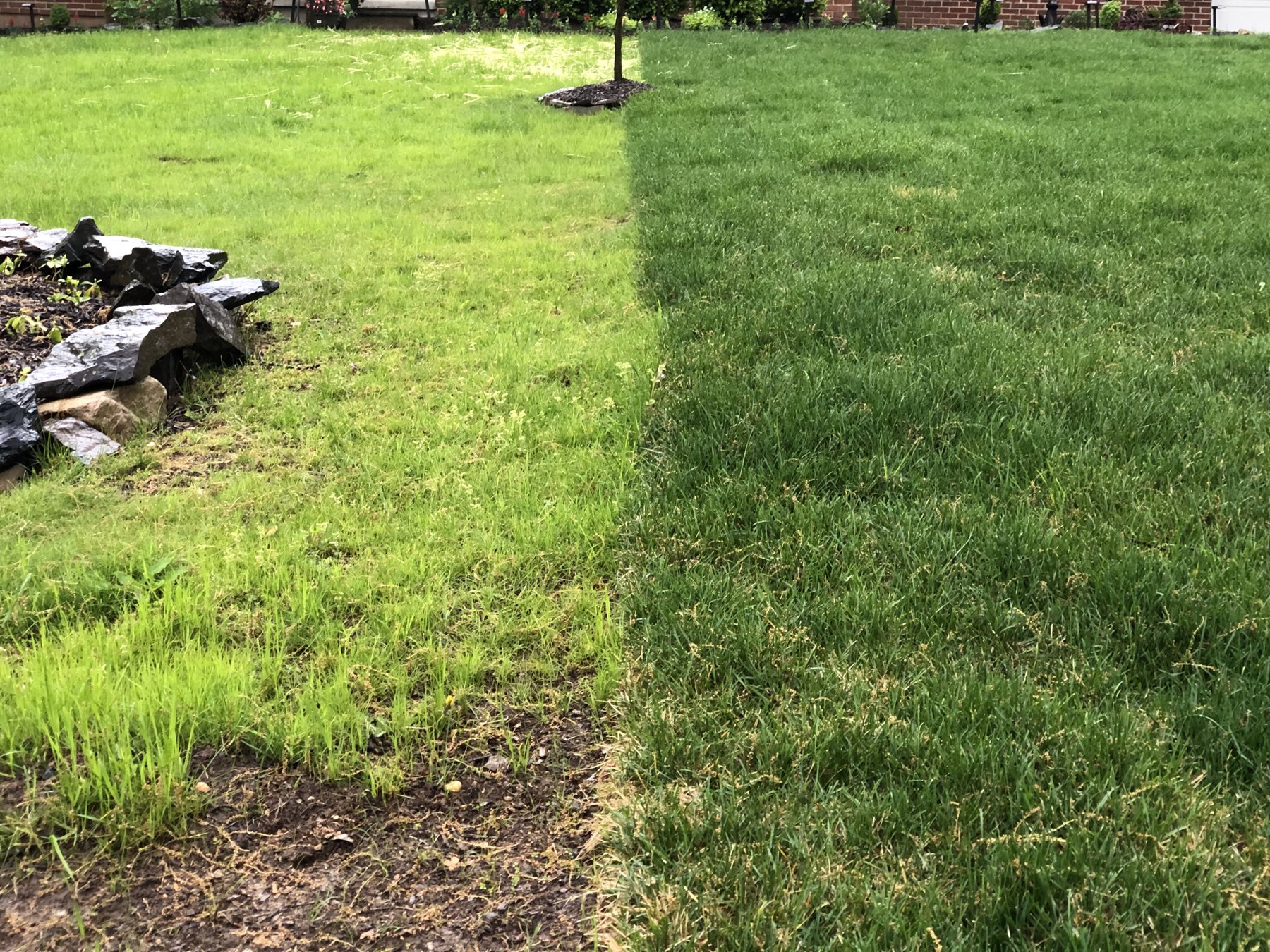
Seed needs to touch soil, and the surest way to get it there is to put it there. A slit seeder cuts shallow grooves and drops seed into them a quarter to half an inch deep; a drill does the same behind a disk and press wheel, 6 to 12 millimetres down. The University of Kentucky’s turf program puts the alternative bluntly: “Just broadcasting seed over a bare soil surface is almost never successful.” The city’s standard names drilling as its default. The Natural Resources Conservation Service’s standard for seeding disturbed ground, in its Kansas and Vermont versions, names a drill as the preferred tool and reserves broadcasting and hydroseeding for ground too steep for equipment.
The one direct test of drilling against hydroseeding found for this article comes from Texas highway trials, where drilled seed gave better stands than hydroseed at two of four sites, “probably because less seed washed from the planted area.” The same report found that hydroseeding “is seldom successful without some soil disturbance” and that its uniformity “depends upon a conscientious hydroseeder operator.” The trials used native grasses, not lawn turf. Freshly backfilled trenches settle, so they are firmed and leveled before the seeder goes over them.
Four and five: drop spreader, rake, roll and crimped hay
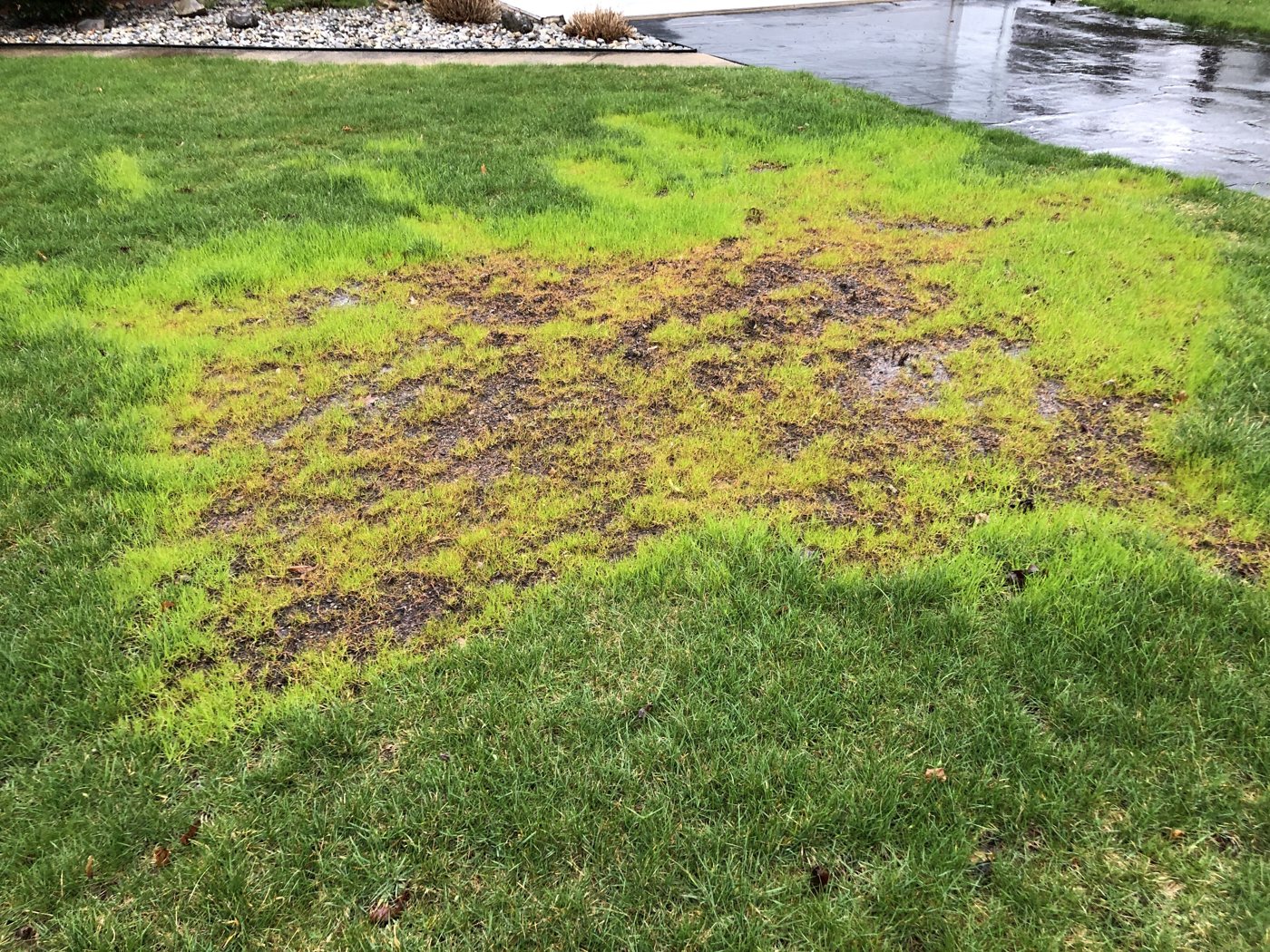
Without a seeder the method is older and simpler. Seed goes down from a drop spreader in two directions at half rate each, falling a few inches from the hopper; it is raked in lightly until about a tenth of it still shows, then rolled. SDSU Extension notes that a drop spreader is “more accurate when working around flower gardens, sidewalks and ponds” and drops seed “at precisely the same width all over,” while a broadcast spreader covers three to four times its own width. A cover of clean hay or straw, about a bale per thousand square feet, holds moisture and soil. The city’s standard wants it crimped four inches into the ground, and for good reason: Forest Service wind-tunnel tests found that loose wheat straw began to move at about 14.5 miles an hour.
This is close to what the city said it would do. On 2 September 2026, KELO-FM reported that crews would install the irrigation system “before reseeding grass next spring.”
Six: seed blankets, and the cold
The fall seeding window in eastern South Dakota closes in mid-September. SDSU Extension’s worked example for Aberdeen puts the best dates between 7 and 16 September, and Purdue warns that each week of delay can add two to four weeks before turf is ready to use. By mid-October, seed that sprouts has too little time to harden before the ground freezes. The answer the turf programs give is to wait. Dormant seeding puts seed down once the top inch of soil is below about 40°F, which in Minnesota and South Dakota usually means November. The seed lies still through the winter, freezing and thawing work it into the soil, and it comes up in April and May.
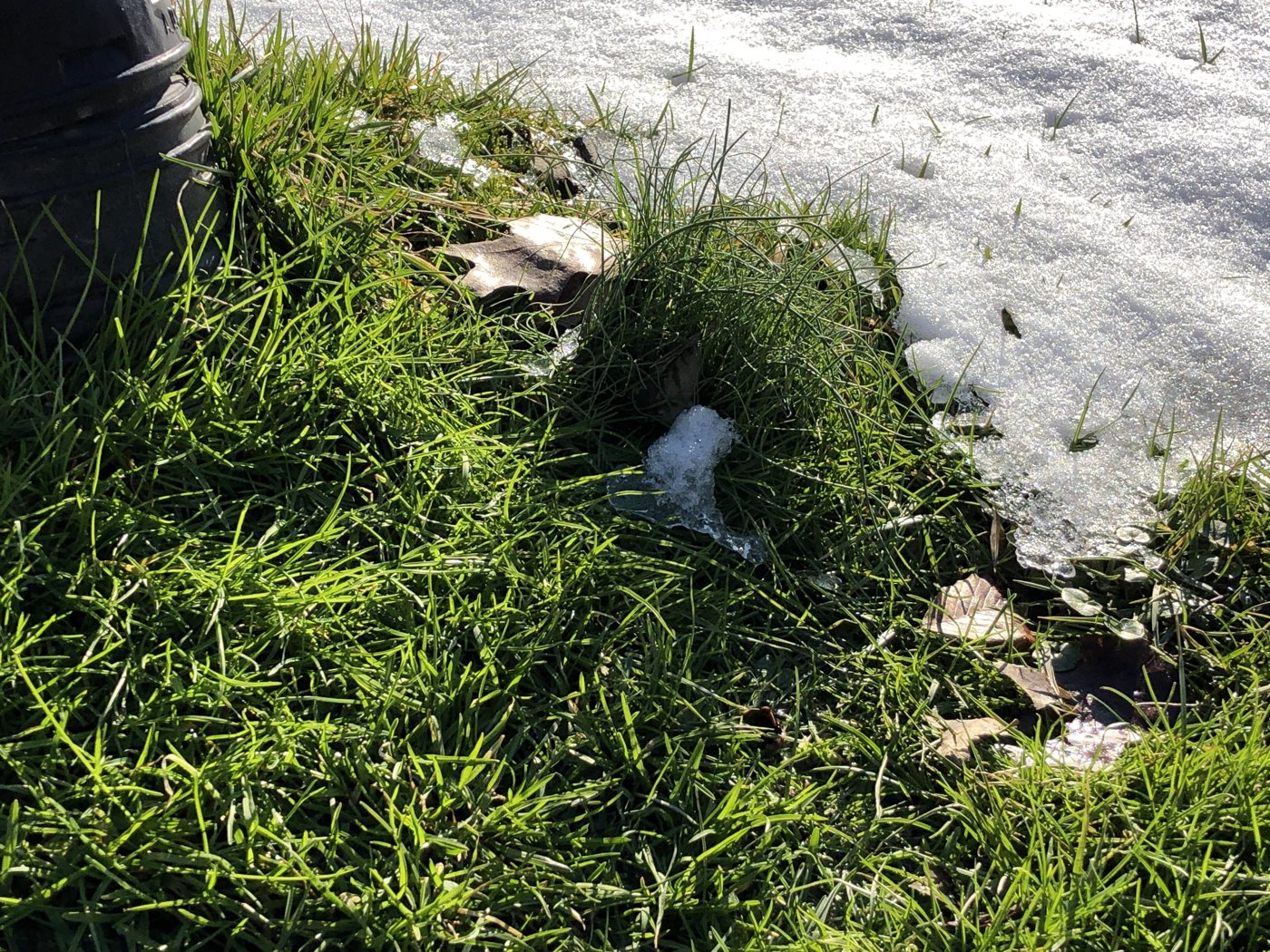
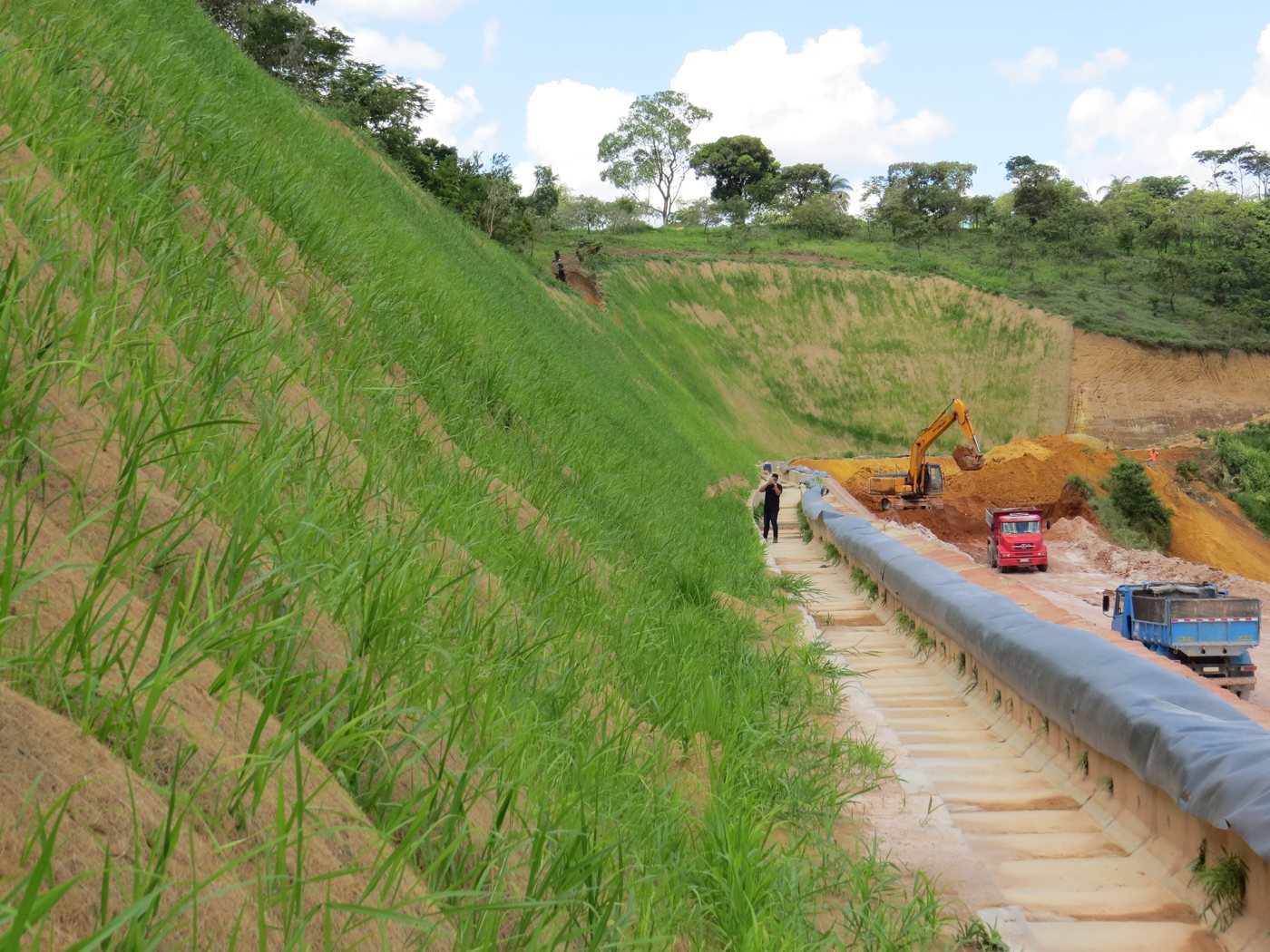
A blanket makes the difference, and it is unrolled, not sprayed. In a University of Minnesota demonstration planted in the fall of 2022, every cool-season species sown under a germination blanket had come up by 1 May, while seed raked into bare soil had mostly failed by the same week; the demonstration had no replicated plots, so it shows a direction rather than a measured effect. Minnesota’s highway research is firmer. Under natural rainfall, straw, coconut and wood-fiber blankets let through about a tenth of the erosion of anchored straw, and a sprayed bonded-fiber mulch failed early once runoff concentrated. Dormant seeding under a blanket needs no watering and no machine that throws anything.
Seven: compost
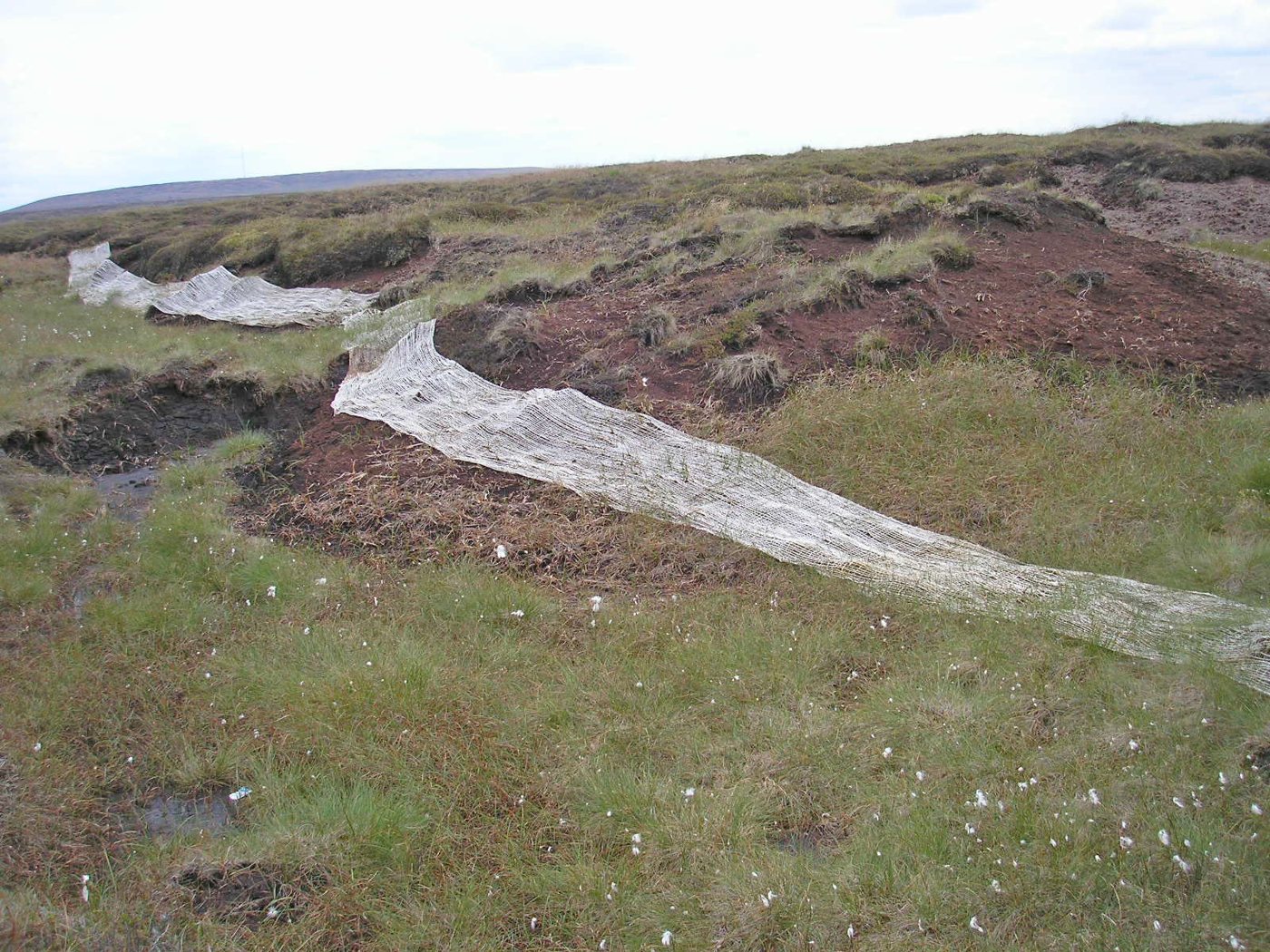
A compost blanket is one to two inches of finished compost with seed mixed in, spread over the strip by loader and rake. On Georgia construction sites, compost blankets produced 2.75 times the plant cover of hydroseed after three months; by a year the cover had evened out, but the hydroseeded plots carried more weeds. Iowa State highway trials found two inches of compost controlled erosion as well as four. The pneumatic blower trucks often used to apply compost should not be used near people: they throw fine material into the air, and NIOSH has measured dust and airborne Aspergillus downwind of compost handling. Spread by hand, compost stays where it is put.
Side by side
| Method | In the air | How it works | When, in Sioux Falls | Cost |
|---|---|---|---|---|
| Hydroseeding, as done | Slurry thrown through the air | Seed, wood or paper fiber, dye, fertilizer and tackifier mixed with water and sprayed from a hose or cannon | The ordinary seeding dates; mid-October is past them | $0.21 a sq ftSDDOT 2024 average, 3 projects |
| Sod | Nothing | Kentucky bluegrass cut within a day or two, laid in a brick pattern, rolled, watered daily for two weeks | Any time the ground is not frozen; early fall is best | $1.05 a sq ftMnDOT 2025 average, 7 contracts |
| Dormant seed under a blanket | Nothing | Seed dropped on bare soil once it is too cold to sprout, covered with a biodegradable blanket | Once soil is below 40°F, usually November | $0.33–0.40 a sq ftSDDOT 2024 blankets, plus seed |
| Slit or drill seeding | Nothing | Seed cut a quarter to half an inch into firm soil, then rolled | 15 August to mid-September, or spring | $0.08–0.18 a sq ftConsumer price surveys, 2025 |
| Seed, rake, roll, crimped hay | Chaff, if blown | Seed from a drop spreader, raked in and rolled, under weed-free hay crimped into the soil or laid by hand | 15 August to mid-September, or spring | about 1.5¢ a sq ft for mulchSDDOT 2024 straw mulching, plus seed |
| Compost blanket | Dust, if blown | One to two inches of compost with seed mixed in, spread by loader or rake | The seeding dates | $0.15–0.30 a sq ftMnDOT 2025 compost, before spreading |
Bid prices are averages from state highway contracts, which buy at a scale no park job matches; a narrow trench costs more per square foot by any method. They compare methods with one another and are not a quote for the park.
The calendar
If a slurry is sprayed anyway
No hydroseeding specification found for this article sets a wind limit in miles an hour. The South Dakota DOT says only that seed is not sown “when the wind interferes with uniform seed application” and that mulching stops “during periods of high winds.” The practices below come from spray-drift science, where the numbers do exist.
- Spray between 3 and 10 mph
Pesticide labels give this as the range of least drift. Below 3 mph on a clear morning the air can stratify and carry fine droplets far; above 10 the wind carries them. The park saw 16 to 21 mph in the windiest hours of the spraying.
- Fan tip, held low, short throw
Kansas DOT asks for a 50-degree fan tip wherever possible. The shorter the arc, the less time a droplet spends in moving air.
- Lower pressure, larger orifice
Both shift a spray toward larger droplets, the principle behind every drift-reduction nozzle the EPA rates.
- Mulch in a separate pass
The city’s standard requires it whenever seed is applied hydraulically.
- Close the area and post it
The General Conditions require the project to be secured from public use, and §95.032 gives the parks director the power to close an area with a conspicuous notice. Glencoe, Minnesota gave its residents the hydroseeding dates in 2023 and asked them to keep “all traffic (including people and pets)” off the seeded areas.
- Publish the safety sheets
Fiber-mulch safety data sheets list wood dust as an irritant and sensitizer, and one tackifier sheet lists respirable crystalline silica. Composition varies by product, and only the sheets for what was used settle the question.
What the research does not show
No study by a state transportation department, the USDA, the EPA or NIOSH has measured droplet size, drift distance or bystander exposure from hydroseeding. Specifications police overspray on pavement and buildings, not the air. Nor has any peer-reviewed trial compared hydroseeding, dry seeding and sod on Kentucky bluegrass or ryegrass lawn; claims of faster germination from hydroseeding come from those who sell it. That absence cuts one way. A method that sends material into the air beside homes has never been shown to be safe for the people breathing it, and the methods that keep it on the ground do not need to be.
Sources
- J. M. Cimbala, Particles, lecture slides for ME 433, Air Pollution Control, Pennsylvania State University, 2015: “How small of a particle can we see?”
- Ontario Ministry of Agriculture, Food and Agribusiness, Pesticide drift from ground applications.
- Sioux Falls Code of Ordinances, §92.070–92.071 (nuisances), §95.005 and §95.032 (parks), §157.175–157.176 (erosion control), §90.107 (spraying), via American Legal Publishing, read 22 October 2026.
- City of Sioux Falls, General Conditions for Public Improvements, 2024, §4.5, §5.4, §7.7, §7.10, §7.21.
- B. Folck, Genotypic variation in germination rate of Kentucky bluegrass, University of Nebraska–Lincoln; Purdue University, Kentucky bluegrass, forage identification.
- M. Doorn, “Fall finish dates in sight for several Sioux Falls park projects,” KELOLAND News, 8 September 2026.
- City of Sioux Falls, Engineering Design Standards, Chapter 12, Erosion and Sediment Control, revised 16 January 2023, §12.2.2, §12.2.3 and Table 12.3.
- South Dakota Department of Transportation, Standard Specifications for Roads and Bridges, §730 Seeding, §732 Mulching, §733 Sodding; and 2024 Bid Item Price Report.
- Minnesota Department of Transportation, Average Bid Prices for Awarded Contracts, 2025.
- Iowa Statewide Urban Design and Specifications, Division 9, Section 9010, Seeding, 2024.
- S. Bauer, B. Mugaas and D. Pedersen, Seeding and sodding home lawns, University of Minnesota Extension, revised 2024.
- J. Trappe, Dormant seeding, University of Minnesota Extension, revised 2025; A. Hollman, Investigating dormant seeding as an approach to establish lawns in Minnesota, UMN Turfgrass Science, 2023.
- Z. Reicher, C. Bigelow, A. Patton and T. Voigt, Establishing Turfgrass Areas, AY-3-W, Purdue Extension; Z. Reicher and others, Establishing Lawns From Sod, University of Nebraska–Lincoln, 2012.
- Owens, Schnabel and Lang, Renew Your Lawn This Fall With Overseeding, SDSU Extension, 2021.
- University of Kentucky Turf Program, Cool-season athletic field programs.
- J. Simpkins, Establishment of Grass Mixtures on Roadsides, Texas Transportation Institute Report 902-6, 1993–94.
- L. B. Faucette and others, “Vegetation and soil quality effects from hydroseed and compost blankets used for erosion control in construction activities,” Journal of Soil and Water Conservation 61(6): 355–362, 2006.
- S. R. Benik, B. N. Wilson, D. D. Biesboer, B. Hansen and D. Stenlund, Efficacy of Erosion Control Blankets and Soil Stabilizers, MnDOT Report 2000-15.
- US Environmental Protection Agency, Compost Blankets, stormwater best management practice fact sheet.
- Kansas Department of Transportation, hydromulch specification, fan-type nozzle with a 50-degree tip; EPA-registered pesticide label PPLS 000400-00541, drift guidance for 3 to 10 mph; Minnesota Department of Agriculture, herbicide drift management card.
- N. S. Copeland, B. S. Sharratt, J. Q. Wu, R. B. Foltz and J. H. Dooley, “A wood-strand material for wind erosion control,” Journal of Environmental Quality 38: 139–148, 2009.
- USDA Natural Resources Conservation Service, Conservation Practice Standard 342, Critical Area Planting, Kansas and Vermont versions.
- J. Burkhart, NIOSH Health Hazard Evaluation HETA 95-0198-2765, composting facility, Springfield, Missouri, 1999.
- Minn. Stat. §18B.09; Iowa Admin. Code r. 21-45.50; Wis. Admin. Code ATCP 29.56. City of Glencoe, Minnesota, project update, September 2023.
- L. Ryan, McKennan Park wading pool will have a new look next year, KELO-FM, 2 September 2026.
Photographs: Hydroseeding an embankment at the Chețani junction of Romania's A3 motorway, by Kulja, CC0, via Wikimedia Commons. Workers lay sod on the campus of Yale University, by Ragesoss, CC BY-SA 3.0; sod on a pallet, Arlington, Massachusetts, by Daderot, CC0; sod installation by Distinct Lawns, CC BY-SA 4.0; all via Wikimedia Commons. Newly sodded and newly seeded lawns, grass under melting snow, and a newly seeded lawn in spring, Ewing Township, New Jersey, 2023 and 2024, by Famartin, CC BY-SA 4.0, via Wikimedia Commons. Coconut-fiber blanket over a seeded slope, 20 days after seeding, by Matheus Guilherme Brasil Santos, CC BY-SA 4.0; jute erosion netting on moorland by John Illingworth, CC BY-SA 2.0; both via Wikimedia Commons. Sodding a slope on the new Fall River Road, 4 June 1934, by Dorr G. Yeager, Rocky Mountain National Park; public domain, via Wikimedia Commons.