No warning of green spray — can you smell or taste it?
One
What residents were told: nothing.
A city park is shared ground, and spraying it in front of the homes that face it is the kind of work that is ordinarily announced. This was not. Every place a notice could reasonably have appeared was checked on 21 October 2026.
0signs posted in the park
0notices to the homes that face it
0 of 10city news releases, 13–21 October, that mention the park
0 of 289neighborhood-group posts that mention the work
In the park
No sign at any entrance and none beside the treated strips, the morning of 21 October 2026, after several days of spraying.
At the door
No letter, flyer or email to the homes that face the park.
City newsroom
Ten news releases published 13 to 21 October 2026. Lane closures, street construction, an aquatic-centre anniversary, a water-system test. None mentions McKennan Park.
City park page
The city's McKennan Park page, read 21 October 2026, says nothing about irrigation work, seeding, spraying or areas to keep off.
Neighborhood group
289 posts to the Friends of McKennan Park Facebook group between October 2025 and 10 October 2026. None mentions the irrigation project, seeding or spraying.
Last public word
KELO radio, 2 September 2026: crews would install irrigation over the winter “before reseeding grass next spring.” The October seeding was never announced.
South Dakota does not require a notice. State law lets the Secretary of Agriculture and Natural Resources adopt a posting rule for pesticide applications (SDCL 38-21-56), and no such rule for turf has been adopted. The neighbors on either side do it differently. Minnesota requires warning signs in cities that adopt the state's ordinance, and for parks it puts them at the entrances and beside every treated area for 48 hours, reading “This area chemically treated.” Iowa requires commercial and public applicators in urban areas to post signs from the start of an application through the next 24 hours, and to call ahead for any adjoining resident who asks in writing.
Two
A $646,739 irrigation project.
The trenches are the city's irrigation project. On 27 March 2026 the City of Sioux Falls put McKennan Park Irrigation System Improvements out to bid as project 26-1045, funded under capital-improvement line 14009, at an engineer's estimate of $646,739.18.
In September, KELO reported that the wading pool's closing for the season would let crews “start installing an irrigation system before reseeding grass next spring.” The old system was about fifty years old, the same age as the pool it served. The new one would cost about half a million dollars, and the donors Pierce and Barbara McDowell were covering it. Officials hoped to finish by the end of winter.
So the one public timeline said the seeding would come in the spring. It came in October, with no update to that timeline in the city’s newsroom or on its park page.
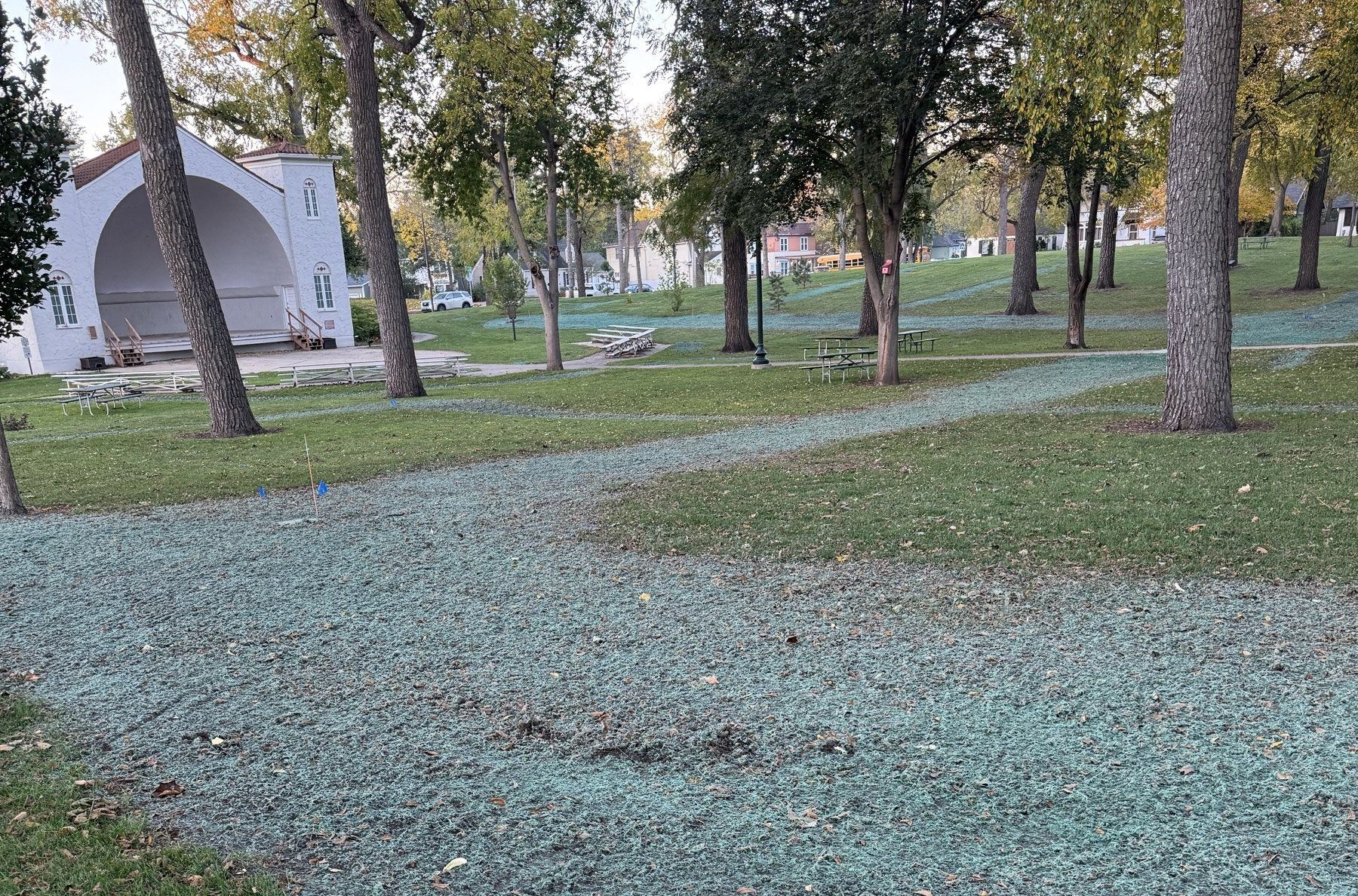
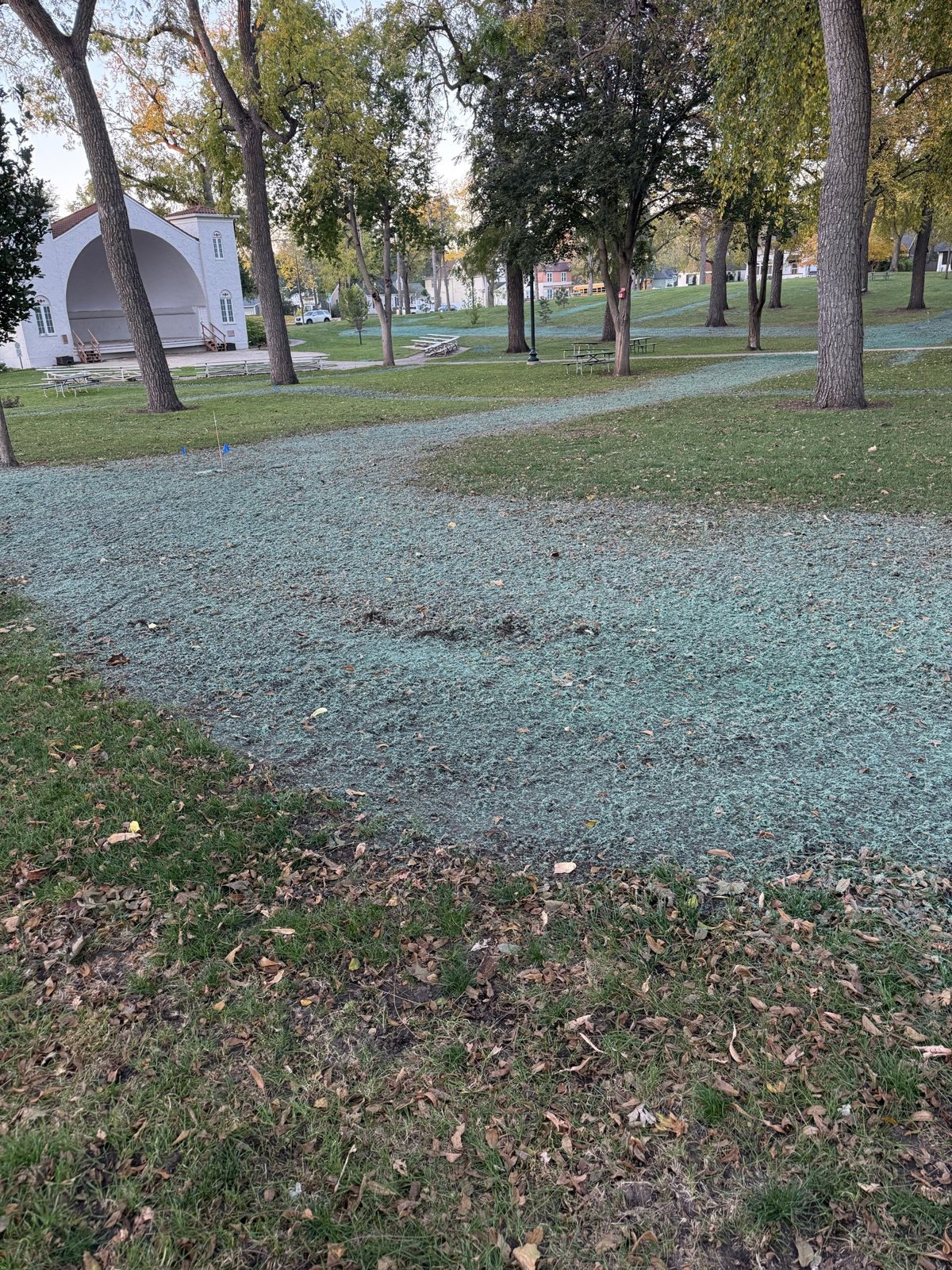
Looking north toward the band shell, 21 October 2026. The green strips follow the trench lines; the small blue flags are utility locate marks. Photograph of the hydroseeded irrigation trenches in McKennan Park, 21 October 2026, 8:02 a.m., taken for this site.A crop from the same photograph at full resolution. The green layer is a mat of fibers lying on the soil, not a liquid that soaked in.
Three
What the green is.
It is hydroseed: grass seed, a fiber mulch, a binder and usually a starter fertilizer, mixed with water in a truck-mounted tank and thrown through a hose or cannon at high pressure. The mulch holds moisture against the seed and keeps rain from washing the backfill away. The dye is there so the operator can see where coverage is complete, and it fades within a week or two as the grass comes up.
The photograph settles what the visible layer is. A dissolved spray soaks in and leaves nothing to see; this is a fibrous crust sitting on top of the soil, confined to the disturbed strips. What the photograph cannot settle is what else went into the tank. The dye that makes the job easy to see is also what makes the rest of the recipe impossible to see.
Specifications give a sense of the quantities. Fargo's municipal seeding standard calls for 2,000 pounds of hydromulch and 110 pounds of 24-24-4 turf fertilizer per acre. A trench network running through a twenty-acre park is a fraction of an acre, but it runs beside the paths people walk every day.
Ingredient
Usual form
In this tank
Job
Fiber mulch
Wood fiber, recycled paper or a bonded-fiber blend
Visible in the photograph
Holds moisture against the seed
Colorant
Green marking dye
Visible in the photograph
Shows the operator where coverage is complete
Grass seed
Bluegrass, perennial rye, fescue
Near certain
The point of the job
Starter fertilizer
Urea, ammonium phosphate or a blended N-P-K
Very likely
Feeds the seedlings
Tackifier
Guar gum, psyllium or polyacrylamide
Likely
Glues the mulch to the soil
Seed coating
Fungicide film on the seed
Possible
Prevents seedling rot
Seed-safe herbicide
Mesotrione or siduron
Possible
Suppresses weeds without killing new grass
Broadleaf herbicide
2,4-D, MCPP, dicamba
Unlikely in this tank
Injures seedlings; used on established turf instead
Four
The smell, the taste, and the wind.
Two sources fit what people describe. The first is ammonia. Urea, the commonest nitrogen in starter fertilizers, turns to ammonia gas on a moist surface, and the loss is greatest when wet ground dries in the wind. Field trials put it at 1 to 19 percent of the applied nitrogen in Wisconsin and an average of 21 percent across twelve Montana sites. Freshly sprayed hydromulch is exactly that wet-then-drying surface, and fertilizer salts carried in the mist leave a salty or metallic taste.
The second is diesel exhaust from the engine and pump, which run for the whole job, usually beside the curb.
The cannon throws part of the slurry as droplets fine enough to drift, and the week was windy. Daytime wind at the park:
Day
Mean
Strongest hour
Peak gust
Sun 12 Oct
8 mph
16 mph
34 mph
Mon 13 Oct
7 mph
10 mph
21 mph
Tue 14 Oct
6 mph
7 mph
16 mph
Wed 15 Oct
10 mph
18 mph
34 mph
Thu 16 Oct
16 mph
21 mph
44 mph
Fri 17 Oct
15 mph
17 mph
34 mph
Sat 18 Oct
12 mph
14 mph
28 mph
Sun 19 Oct
6 mph
8 mph
17 mph
Mon 20 Oct
10 mph
13 mph
26 mph
7 a.m. to 5 p.m. Central, from the Open-Meteo historical archive at the park's coordinates. The morning of 21 October, when the photographs were taken, was close to calm.
Hydroseed has no wind limit in law. Herbicide labels do: many prohibit spraying when the wind exceeds 10 to 15 miles an hour, because drift is the main way a spray reaches people who did not choose to be near it. On four of these nine days the strongest daytime hour reached 16 to 21 miles an hour, with gusts to 44.
Five
How a spray ends up in your mouth.
A hydroseeder does not pour its slurry; it throws it. A pump drives the mix through a hose or a deck cannon at high pressure, and as the jet leaves the nozzle it tears itself apart into droplets. Most are large and land where the operator aims. A fraction are small, and the physics of small droplets is different enough from the physics of big ones that they behave like a different substance.
Size decides everything
Droplets are measured in micrometres, thousandths of a millimetre. A drop from a garden hose is about 1,000 µm across. A human hair is roughly 50 to 100. Fog is 10 to 20. When a liquid jet breaks up, it produces the whole range at once, and pushing the same liquid through at higher pressure shifts the range toward the small end. Spray-application guidance treats droplets smaller than about 150 to 200 µm as the drift-prone fraction: small enough that the wind, not the nozzle, decides where they go.
Small droplets fall slowly, and the wind does the rest
Air resists a falling droplet in proportion to its size, while gravity pulls in proportion to its volume, so shrinking a droplet ten times cuts its weight a thousand times but its drag only ten. The result is a fall speed that collapses as droplets get small. A 1,000 µm drop falls about 4 metres a second and is on the ground in under half a second. A 100 µm droplet falls at 27 centimetres a second. A 10 µm droplet falls at 3 millimetres a second, slower than the air moves when you breathe out. The drift distance is simply the wind speed multiplied by the time the droplet spends in the air.
Distance a water droplet travels before reaching the ground, released at head height (1.5 m) in a steady 10 mph wind, drawn on a log scale. Each step down in size multiplies the distance. Fall speeds: Stokes’ law for droplets of 50 µm and smaller, measured values (Gunn and Kinzer, 1949) above that. Real air is turbulent, which keeps the smallest droplets up longer still.
At the 16 to 21 mph that the windiest hours reached in the days of spraying, every distance in that chart grows by 60 to 110 percent. A 50 µm droplet released at head height would cross about 470 to 615 feet of park before landing.
Evaporation makes small droplets smaller
Water leaves a droplet from its surface, and a small droplet has far more surface for its volume. A rule long used in spray science estimates a droplet's lifetime in seconds as its diameter squared divided by eighty times the wet-bulb depression, the gap in degrees Celsius between the air temperature and what a wet thermometer reads. On a cool October day that gap is perhaps 2 to 5 degrees. A 100 µm droplet then lasts 25 to 60 seconds, long enough to land. A 50 µm droplet lasts 6 to 16 seconds, less than the 20 seconds it needs to fall from head height, so it never lands as a droplet at all. The water goes; what was dissolved or suspended in it, fertilizer salt, dye, binder, any additive, stays behind as a smaller, drier particle that floats longer still.
Calm is not always safe
On clear, still mornings the ground cools the air just above it, and a layer of cool, heavy air sits under warmer air. Meteorologists call it an inversion. Inside one, fine droplets and particles do not mix upward and dilute; they hang near the ground in a concentrated cloud and slide sideways with the faintest air movement, sometimes for hundreds of feet. This is why spray guidance warns against application when the wind is under about 3 mph on a clear morning as firmly as it warns against strong wind. The morning of 21 October was close to calm.
Gas goes where droplets cannot
Ammonia from fertilizer is not a droplet. It leaves the drying mulch as a gas, and a gas does not settle; it spreads with the air until it is diluted. That is why a fertilizer smell can reach a porch or an open window when no droplet could, and why it lingers for a day or two after the spraying stops, strongest when the ground is wet and drying.
Where each size lands in the body
Size
Where it is caught
What you notice
Larger than 10 µm
Nose, mouth and throat. These are caught by the wet surfaces of the upper airway and swallowed.
Taste, smell, a scratchy throat, sneezing
2.5 to 10 µm
The windpipe and larger airways of the lungs, the band air-quality rules call PM10.
Cough, chest tightness in people with asthma
Smaller than 2.5 µm
The deep lung, the air sacs where oxygen crosses into the blood, the band called PM2.5.
Often nothing at the time
That last table explains the taste. Tasting something means droplets or particles have landed on the tongue and the back of the throat, which happens mostly with material larger than about 10 µm. Those are the heavier members of the drifting fraction, so a taste in the mouth is direct evidence that spray reached the air people were breathing, and it says nothing reassuring about the smaller particles that go deeper without being tasted at all.
Six
The health evidence, ingredient by ingredient.
Ingredient
What the evidence shows
Strength
Fiber mulch
Dry mulch becomes nuisance dust that irritates eyes and airways. No chronic hazard is established for wood or paper fiber at outdoor exposures.
Irritant
Colorant
Formulated for low toxicity, but dye identities are often withheld as trade secrets. Only the product's safety data sheet settles it.
Unknown without the sheet
Urea and ammonia
Ammonia irritates eyes, nose and throat on contact, more so for people with asthma. Outdoors, from a fertilized surface, the effect is irritation rather than injury.
Established, short-term
Polyacrylamide
The polymer has low toxicity. Its residue, acrylamide monomer, is classed by IARC as probably carcinogenic (Group 2A). Safety data sheets for anionic tackifiers carry a suspected-carcinogen line for that residue, with limits ranging from 0.05 percent in one patented formula to under 1.2 percent on one commercial sheet.
Depends on the product
Diesel exhaust
The hydroseeder's engine and pump run for the whole job. IARC classes diesel engine exhaust as carcinogenic to humans (Group 1) for lung cancer, a finding built on years of occupational exposure.
Settled, dose-dependent
Mesotrione
Blocks the plant enzyme HPPD, the same target as nitisinone, a drug given to children with the metabolic disease tyrosinemia. Labels carry eye first-aid statements and require gloves and protective clothing for handlers, and warn that it leaches to groundwater and runs off to surface water for months.
Low acute toxicity
Dogs
Dogs are the best-studied bystanders to lawn chemistry because they walk, roll and lick at ground level. In a Purdue case-control study of Scottish Terriers, dogs exposed to herbicide-treated lawns had a higher risk of bladder cancer than dogs on untreated lawns, the risk tied to phenoxy herbicides such as 2,4-D. A follow-up found those herbicides in the urine of dogs after lawn applications, including dogs from untreated yards, which points to drift and tracking. That work concerns broadleaf herbicides rather than hydromulch, but the lesson carries to any park full of dogs: keep dogs off the strips until they are dry, and do not let them eat the mulch, since starter fertilizer makes them sick.
Seven
Symptoms to watch for.
Almost everything in a hydroseed tank acts on contact, so the symptoms that matter show up within minutes to hours of being near the spraying, and they ease once you are away from it. The list below follows the ingredients most likely to be in the air or on the ground.
Exposure
What it feels like
Fertilizer mist and ammonia
Burning or watering eyes, runny nose, scratchy or sore throat, cough, a salty or metallic taste. In people with asthma, chest tightness and wheezing.
Wet slurry on skin
Redness, itching or a rash where it touched, most often on hands, ankles and shins. Fertilizer salts dry the skin.
Dry mulch dust
Gritty eyes, sneezing, a dry cough, worse on windy afternoons once the strips dry out.
Diesel exhaust near the truck
Headache, stinging eyes and throat, nausea or light-headedness. Asthma flares in sensitive people.
Herbicide drift, if any was used
Eye and skin irritation and coughing at the levels a bystander meets. Nausea, vomiting, and muscle twitching or weakness belong to heavy exposures, usually swallowing concentrate, not walking past.
Children
Children are closer to the ground, breathe more air for their size, and put their hands in their mouths. A child who has played on a fresh green strip should wash hands and face before eating. Mild redness of the hands or face, an upset stomach after mouthing the mulch, or watery eyes are the usual signs; vomiting more than once, a rash that spreads, or any breathing trouble is a reason to call.
Signs in a dog
Sign
What it can mean
Vomiting, drooling or diarrhea
Eating mulch or licking fertilizer off the paws. Usually passes within a day.
Not eating, a tight or swollen belly
A large amount of fiber mulch swallowed. Wood and paper fiber can block the gut; call a veterinarian.
Red, itchy paws or belly
Contact irritation from the slurry. Rinse the paws after walks until the strips are dry.
Blood in the urine, straining to urinate
A long-term sign, not an acute one, and worth a veterinary visit at any time. It is the symptom of the bladder cancer studied in dogs exposed to herbicide-treated lawns.
When to get help
Call 911
Trouble breathing, wheezing that an inhaler does not settle, chest tightness, confusion, or collapse.
Poison Control
1-800-222-1222, free and staffed around the clock. Call for eye pain or blurred vision that does not clear after rinsing, repeated vomiting, a child who has eaten the mulch, or symptoms that last more than a day after leaving the park.
For a dog
Your veterinarian, or the ASPCA Animal Poison Control Center at 888-426-4435 (a consultation fee applies). Call for repeated vomiting, a dog that will not eat or drink, weakness, or blood in the urine.
Write it down
The date, time and place, the wind, what you smelled or tasted, and who had symptoms. If the city later releases the product sheets, a doctor or veterinarian can match them to what happened, and a dated note is what makes a complaint to the state Department of Agriculture and Natural Resources, which investigates pesticide misuse, more than a recollection.
Eight
The cancers linked to these chemicals.
Cancer is the long-run question, and the honest answer runs ingredient by ingredient. The International Agency for Research on Cancer grades how strong the evidence is that a substance can cause cancer at all: Group 1 means it does, Group 2A probably, Group 2B possibly. None of those grades says anything about the dose a passer-by receives, and every human finding below comes from people exposed at work for years.
Substance
Cancers associated
Grade and strength
Relevance here
Diesel engine exhaust
Lung cancer; limited evidence for bladder cancer
IARC Group 1 (2012). Established in miners, rail and truck workers.
The truck idles beside the job for hours; the dose to a passer-by is small.
Wood dust
Cancers of the nasal cavity and sinuses
IARC Group 1. Established in furniture and cabinet workers breathing fine dust daily.
Relevant only if dry wood-fiber mulch is ground into dust; outdoor exposure is slight.
Acrylamide (binder residue)
No consistent cancer in human studies; tumors at several sites in laboratory animals
IARC Group 2A, probably carcinogenic.
Only if the binder is polyacrylamide; residue is capped at fractions of a percent.
Glyphosate
Non-Hodgkin lymphoma
IARC Group 2A (2015). A 2019 meta-analysis found 41 percent higher risk in the most exposed. EPA: not likely carcinogenic.
Used on park edges and beds, not in hydroseed.
2,4-D
Non-Hodgkin lymphoma; older studies also report soft-tissue sarcoma
IARC Group 2B (2015), possibly carcinogenic. Human evidence mixed. EPA does not classify it as a carcinogen.
Not in a hydroseed tank; the usual fall broadleaf spray on established turf.
MCPP (mecoprop)
Non-Hodgkin lymphoma and soft-tissue sarcoma, evaluated as part of the chlorophenoxy herbicide group
IARC Group 2B for chlorophenoxy herbicides (1987).
A standard partner of 2,4-D in three-way broadleaf mixes.
Dicamba
Liver and intrahepatic bile duct cancer
Not classified by IARC. NIH Agricultural Health Study: 1.8 times the risk in the highest exposure group (28 cases). Causation not established.
The third partner in three-way mixes.
Mesotrione
None established
Not classified by IARC; EPA classifies it as not likely to be carcinogenic to humans.
Labeled for mixing into hydroseed; the likeliest herbicide if one was used.
Urea and other fertilizer salts
None
No cancer classification.
Almost certainly in the tank.
Herbicides, in dogs
Bladder cancer (transitional cell carcinoma); a disputed earlier study also reported canine lymphoma with owners' use of 2,4-D
Purdue case-control studies of Scottish Terriers, 2004, and urine studies, 2013; Hayes et al. 1991, odds ratio 1.3, about twofold with four or more owner applications a year, criticized for lacking measured exposure.
Phenoxy lawn herbicides, not hydromulch. Since 2005 EPA has required 2,4-D labels to keep pets off treated areas during and right after application.
Two patterns run through the table. The best-established links, diesel exhaust and lung cancer and wood dust and nasal cancer, belong to ingredients present here at a sliver of the occupational dose. The weed killers carry the cancers people worry about most, non-Hodgkin lymphoma above all, but the evidence for them is mixed, the regulators disagree with the cancer agency, and nobody yet knows whether any of them were used in McKennan Park this month. That last question is the one the city's own records answer.
Nine
Could there be weed killer in it?
Possibly, and lawfully. Broadleaf herbicides such as 2,4-D would kill the seed, so a competent contractor leaves them out. A narrower class is labeled for use at seeding, and the market has moved toward putting it in the tank. On 6 February 2026, EPA approved an amendment to the label of a mesotrione product, MESO 4 SC SELECT, whose stated purpose is adding mixing directions for hydroseeding. Siduron is the older seed-safe option.
A separate broadleaf spray on the surrounding lawn, the usual fall dandelion treatment, would leave no trace at all. The evidence on those products is the more developed part of this literature:
2,4-D
IARC, 2015: possibly carcinogenic to humans (Group 2B). The human signal is non-Hodgkin lymphoma among farmers. EPA does not classify it as a carcinogen.
Dicamba
In the NIH Agricultural Health Study, applicators in the highest exposure quartile had 1.8 times the risk of liver and bile duct cancer (95% CI 1.26 to 2.56, 28 exposed cases). Earlier signals for lung and colon cancer faded with longer follow-up, and the authors do not claim causation.
Glyphosate
IARC, 2015: probably carcinogenic (Group 2A). A 2019 meta-analysis put non-Hodgkin lymphoma risk 41 percent higher in the most heavily exposed. EPA's position is that it is not likely to be carcinogenic.
Ten
Lawsuits.
No personal-injury suit over hydroseed slurry turned up in news or court records. The nearest cases are about drift and overspray, and they are property cases. In Michigan, a jury found for a gardener whose lawn and food plants were killed by chemicals drifting from a lawn-care application; on appeal the court struck a $66,150 award for her attachment to the lawn but left the drift claim standing. In British Columbia, two car dealerships sued the City of Penticton and its painting contractor over overspray, calling the work an inherently dangerous activity; the city blamed the contractor.
Herbicide litigation is a different scale. The first Roundup trial, Johnson v. Monsanto in 2018, was brought by a school-district groundskeeper and ended in a $289 million verdict, cut to $20.5 million on appeal. Bayer agreed to about $10.9 billion in settlements in 2020, and a further class settlement of up to $7.25 billion, King v. Monsanto, won preliminary approval in Missouri in March 2026. Then, on 25 June 2026, the Supreme Court held 7 to 2 in Monsanto v. Durnell that federal pesticide law preempts state claims that an EPA-approved label should have warned of cancer, which removes the main theory from thousands of pending cases. Claims of negligent application were not decided. For 2,4-D there is still no consolidated litigation.
Where cities have changed how they treat their own grass, the cause has been ordinances rather than verdicts. Montgomery County, Maryland, banned cosmetic lawn pesticides in 2015, and a state appeals court upheld the ban in 2019; even the industry plaintiffs never disputed the county's right to set the rules for its own parkland. Ontario banned cosmetic pesticides in 2009, and South Portland, Maine, followed in 2016. Notice is the smaller ask, and the cheaper one.
Eleven
What the city can answer.
Every uncertainty on this page is a record the city or its contractor already holds. South Dakota requires commercial applicators to complete a record of each pesticide application by the close of the day, keep it three years, and give a copy to the customer on written request. Here the customer is the City of Sioux Falls, and the records are public under SDCL 1-27.
1
The hydromulch product and its safety data sheet, including the identity of the colorant and the tackifier.
2
The fertilizer product and the rate applied.
3
Any herbicide, fungicide or other additive in the tank, with its EPA registration number and rate.
4
Every pesticide application in McKennan Park from 1 September to 31 October 2026: product, date, rate and the applicator's license number.
5
The contractor awarded bid 26-1045, the restoration specification, and why the seeding moved from spring to October.
6
Whether the city will post signs and notify the homes on the park before the next application, as Minnesota and Iowa require of theirs.
Sioux Falls Parks and Recreation answers at 605-367-7060. Until the records are public, the precautions are the same whatever the tank held: stay out of the mist while the cannon runs, keep children and dogs off the green strips until they are dry, and wash hands after touching the mulch.
Twelve
Sources.
Photographs of the treated trenches, McKennan Park, 21 October 2026, 8:02 a.m., taken for this site.
City of Sioux Falls, news releases, 13 to 21 October 2026, all ten read 21 October 2026; and the city’s McKennan Park page, read the same day.
Friends of McKennan Park Facebook group, 289 public posts, October 2025 to 10 October 2026, collected for this site and searched for irrigation, seeding, spraying, chemicals, herbicide, pesticide, sprinkler and weed.
Open-Meteo historical weather archive, hourly wind at 10 m for 43.5311 N, 96.7226 W, 12 to 20 October 2026, 7 a.m. to 5 p.m. Central.
IARC Monographs vol. 105 (diesel engine exhaust, Group 1) and vol. 60 (acrylamide, Group 2A).
L. T. Glickman et al., “Herbicide exposure and the risk of transitional cell carcinoma of the urinary bladder in Scottish Terriers,” Journal of the American Veterinary Medical Association 224 (2004): 1290–97; D. W. Knapp et al., “Detection of herbicides in the urine of pet dogs following home lawn chemical application,” Science of the Total Environment 456–457 (2013): 34–41; Purdue summary.
D. Loomis et al., “Carcinogenicity of lindane, DDT, and 2,4-D,” Lancet Oncology 16 (2015): 891–92; C. C. Lerro et al., “Dicamba use and cancer incidence in the Agricultural Health Study,”International Journal of Epidemiology 49 (2020): 1326–37; L. Zhang et al., “Exposure to glyphosate-based herbicides and risk for non-Hodgkin lymphoma,” Mutation Research 781 (2019): 186–206.
R. Gunn and G. D. Kinzer, “The terminal velocity of fall for water droplets in stagnant air,” Journal of Meteorology 6 (1949): 243–48, for fall speeds above 50 µm; Stokes’ law below; droplet lifetime by the Amsden (1962) rule, diameter squared over eighty times the wet-bulb depression; U.S. EPA particulate-matter size definitions (PM10, PM2.5).
IARC Monographs vol. 100C (wood dust, Group 1) and Supplement 7, 1987 (chlorophenoxy herbicides, Group 2B); Maine Board of Pesticides Control, memo on Callisto (mesotrione), 2022, citing EPA’s 2020 classification, not likely to be carcinogenic to humans.
H. M. Hayes et al., “Case-control study of canine malignant lymphoma: positive association with dog owner’s use of 2,4-dichlorophenoxyacetic acid herbicides,” Journal of the National Cancer Institute 83 (1991): 1226–31; U.S. EPA, 2,4-D issue response on the canine studies and pet-access label language.